



Economical CNC Lathe Price Range in Southeast Asia, 2026 Domestic Chinese Lathe Quotation vs Japanese and Korean Equipment
Preface
In 2026, global manufacturing capacity keeps shifting to Southeast Asia. Industrial sectors including hardware processing, auto parts, 3C electronics and general machinery are expanding rapidly in Vietnam, Thailand, Indonesia, Malaysia and other Southeast Asian industrial nations, driving strong demand for equipment upgrades among local small and medium-sized processing factories. Economical CNC lathes have become a mainstream procurement choice in the regional machine tool market.
Featured with high cost performance, simple operation and easy maintenance, economical CNC lathes fit small and medium-batch production of general parts perfectly, well matching the production needs of local SMEs.
The Southeast Asian machine tool market shows an obvious two-tier structure. Established Japanese and Korean brands occupy the mid-to-high-end entry-level segment with decades of technical expertise, stable precision and comprehensive global after-sales networks. Chinese domestic CNC lathes, by contrast, dominate the economical machine tool market thanks to a complete industrial supply chain, strict cost control, flexible customization and fast delivery.
According to statistics from the China Machine Tool & Tool Builders' Association and the 2026 JETRO Southeast Asia Manufacturing Industry Report, imports of economical CNC lathes in Southeast Asia rose 17.3% year-on-year in the first half of 2026. Chinese machine tools held over 62% of the market share, Japanese and Korean equipment accounted for 28%, and the rest was taken by products from Taiwan (China), Europe and America.
Due to differences in industrial orientation, labor costs and supporting policies, Vietnam, Thailand, Indonesia and Malaysia have distinct processing demands for CNC lathes, leading to varied budget standards and model selection. Based on the latest 2026 FOB spot quotations for Southeast Asia, this article classifies the price range of mainstream domestic flat-bed and slant-bed economical CNC lathes. It also benchmarks entry-level lathes from Japan (Mazak, Okuma, Citizen) and South Korea (Doosan, Hyundai Wia), and makes a multi-dimensional comparison on procurement cost, hardware configuration, processing performance, maintenance cost and application scenarios. This content provides reliable procurement and selection references for foreign trade buyers and processing factories across Southeast Asia.
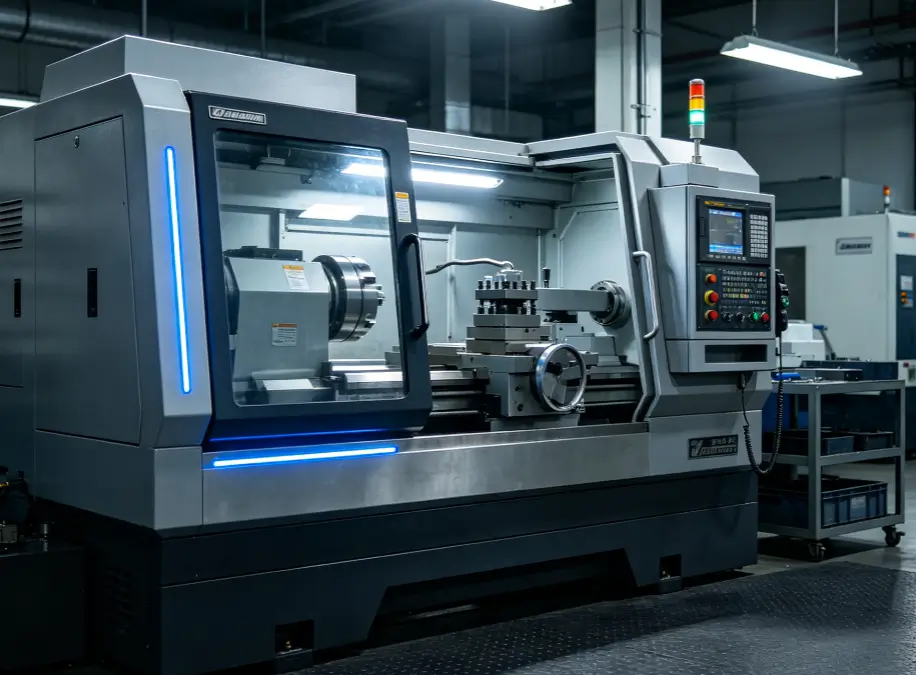
Market Status & Core Pricing Factors of Economical CNC Lathes in Southeast Asia (2026)
1.1 Differentiated Market Demands in Four Core Southeast Asian Countries
Regional manufacturing characteristics directly decide the procurement budget and model selection of CNC lathes, which is the main cause of regional price gaps.
- Vietnam: A major hub for relocated global production capacity. Booming industries include new energy motor shafts, precision fasteners and plumbing parts. Local subsidies cover up to 50% of CNC machine tool procurement costs, greatly stimulating demand for entry-level equipment. The market is dominated by cost-effective CK6140 flat-bed lathes and small TCK40 slant-bed lathes, with mainstream domestic models priced from USD 10,000 to 30,000.
- Thailand: Known as the "automobile manufacturing hub of Southeast Asia". Factories mainly process auto shaft parts, hydraulic components and engine parts, requiring machine tools with high rigidity and cutting stability. Low-end unbranded equipment is gradually phased out. Local buyers prefer linear guideway slant-bed CNC lathes with a general budget of USD 35,000 to 70,000. Large and medium-sized auto parts enterprises tend to choose entry-level Japanese and Korean lathes.
- Indonesia & Cambodia: Focus on light industry such as agricultural machinery accessories, textile hardware and standard fasteners. Production processes are simple with low precision requirements. Buyers prioritize low price, easy operation and low maintenance. Small domestic instrument lathes and low-config flat-bed CNC lathes below USD 10,000 take over 70% of the local market.
- Malaysia: Specializes in semiconductor accessories and precision electronic components, which set high standards for machine tool repeat positioning accuracy and operational stability. The market is mainly supplied by mid-range domestic lathes above USD 40,000 and economical Japanese & Korean models. High-end precision processing is basically monopolized by Japanese and Korean brands.
1.2 Six Core Factors Affecting Lathe Prices in 2026
The pricing of economical CNC lathes is highly transparent. Regional price differences in Southeast Asia are mainly determined by six factors:
- Bed structure: Flat-bed hard guideway lathes are low-cost for roughing and heavy-duty machining. Slant-bed linear guideway lathes deliver better chip removal, higher speed and higher precision, and cost 25%–40% more than equivalent flat-bed models.
- CNC system: Accounts for 25%–30% of the total machine cost. Domestic systems (GSK, KND, HNC) are budget-friendly for entry-level use. Imported systems (Fanuc 0i-TF, Mitsubishi M70) will raise the price by USD 6,000–12,000, which are standard for Japanese and Korean economical lathes.
- Auxiliary configurations: Standard machines with gang tools and manual chucks have the lowest price. Equipped with power turrets, hydraulic chucks, hydraulic tailstocks or automatic bar feeders, the price will increase by 15%–30%.
- Logistics & tariffs: Domestic Chinese lathes are shipped from Guangdong and Zhejiang to Southeast Asia within 7–15 days with sufficient spot goods. Japanese and Korean equipment has longer logistics cycles and higher tariff costs, resulting in higher terminal prices.
- Warranty & after-sales service: Top Chinese brands have built local service outlets in Ho Chi Minh, Bangkok and Jakarta, offering 12–18 month standard warranty and affordable on-site maintenance. Japanese and Korean brands have global warranty systems, yet on-site service and original spare parts come at a high cost.
- Exchange rate & supply-demand: Moderate depreciation of Thai Baht and Indonesian Rupiah, plus surging procurement demand, pushed the overall market price up by 3%–5% in 2026 compared with the start of the year.
Price Range of Domestic Economical CNC Lathes (FOB Southeast Asian Ports, 2026)
Mainstream domestic products are divided into two categories: CK series flat-bed hard guideway lathes and TCK series slant-bed linear guideway lathes. Combined with transaction data from January to June 2026, the prices are sorted by two configuration grades: domestic system (low-end) and imported system (mid-end).
2.1 Flat-bed Hard Guideway CK Series (Best-selling Basic Models)
Flat-bed hard guideway lathes feature solid structure and strong heavy-load capacity, widely used for general hardware, shaft and disc part machining.
- Low-end Version (Domestic GSK/KND System, Gang Tool + Manual Chuck)
- CK6130 small instrument lathe: USD 5,200–9,800 | For micro parts and fasteners, popular in Indonesia and Cambodia
- CK6140 universal lathe: USD 10,500–16,800 | For conventional shaft & disc parts, core model in Vietnam and Thailand
- CK6150 heavy-duty lathe: USD 18,200–26,500 | For large-diameter and heavy components, for construction machinery and large hardware
- Mid-end Version (Fanuc 0i-TF System, Power Turret + Hydraulic Chuck)
- CK6130: USD 12,800–17,500
- CK6140: USD 21,000–29,600
- CK6150: USD 30,800–41,500
Under the same configuration, domestic lathes are only about 60% the price of Japanese and Korean equivalents, with outstanding cost performance.
2.2 Slant-bed Linear Guideway TCK Series (Popular for Precision Machining)
These lathes offer high automation, stable precision and smooth chip removal, ideal for auto parts, 3C electronics and precision hydraulic components. They are major upgrade choices for medium and large factories in Thailand and Vietnam.
- Low-end Version (Domestic System, Gang Tool)
- TCK36 small slant-bed lathe: USD 15,600–22,300 | For mass production of micro precision parts
- TCK40 mainstream slant-bed lathe: USD 23,800–31,500 | Standard model for auto parts
- TCK50 large slant-bed lathe: USD 32,500–42,800 | For medium & large-diameter precision parts
- Mid-end Version (Fanuc System + 8-station Power Turret)
- TCK36: USD 28,500–36,200
- TCK40: USD 37,900–48,600
- TCK50: USD 49,200–61,500
Optional accessory: Automatic bar feeder, extra USD 4,500–7,000, suitable for unmanned mass production of new energy parts.
2.3 Price Gap Between First-tier Domestic Brands & Generic Models
First-tier Chinese brands (Baoji, Shenyang, Yunnan Yiji) command a 12%–20% premium over generic products from small and medium manufacturers, due to clear quality differences:
- Top brands: Adopt HT300 full cast iron bed with secondary aging treatment, stable repeat positioning accuracy at ±0.004mm, no deformation during long-term operation.
- Generic models: Mostly spliced beds with only primary aging treatment, prone to precision drift after half a year, with a failure rate over 30% higher.
For factories with long-term production plans, first-tier domestic lathes deliver better overall value.
Quotation of Japanese & Korean Economical CNC Lathes in Southeast Asia (2026)
Japanese and Korean brands have long-standing market presence and high brand recognition, focusing on mid-to-low-end entry-level precision machining for factories with sufficient budget and strict requirements on precision and stability.
3.1 Japanese Brand CNC Lathes
Japanese lathes are renowned for high precision, excellent stability and low failure rate, all equipped with original Fanuc or Mitsubishi systems for long-term high-intensity mass production.
- Mazak entry-level flat-bed lathe: USD 38,000–52,000
- Mazak small slant-bed lathe: USD 55,000–75,000
- Okuma economical lathe: Price similar to Mazak, for heavy-duty precision machining, mainly supplied to leading auto part enterprises in Thailand and Malaysia
- Citizen small precision lathe: USD 45,000–68,000, monopolizes the high-end 3C precision processing market
3.2 Korean Brand CNC Lathes
Doosan and Hyundai Wia products have better cost performance than Japanese brands, dominating the regional mid-range market.
- Doosan entry-level flat-bed CNC lathe: USD 32,000–45,000
- Doosan slant-bed economical lathe: USD 48,000–62,000
- Hyundai Wia: 5%–8% lower than Doosan for the same specification, a popular alternative to Japanese equipment for medium-sized factories.
Comprehensive Comparison: Domestic vs Japanese & Korean Lathes (2026)
4.1 Procurement Price
With identical specifications and configurations, domestic economical CNC lathes cost only 55%–65% of Japanese and Korean products.
Example: A mainstream 40-spec slant-bed lathe with Fanuc system costs around USD 40,000 for domestic models, over USD 50,000 for Doosan (Korea) and over USD 60,000 for Mazak (Japan). Domestic equipment cuts upfront investment by 35%–45% and eases capital pressure greatly.
4.2 Performance & Precision
For general economical machining scenarios, high-end domestic lathes have almost no precision gap with Japanese and Korean counterparts. Top domestic models achieve repeat positioning accuracy of ±0.004mm, fully meeting the requirements of auto parts, hardware and ordinary 3C component processing.
Japanese and Korean equipment shows better long-term precision stability with slower precision attenuation under decades of continuous heavy use. Considering the 3–5 year equipment iteration cycle of most Southeast Asian SMEs, domestic lathes are fully competent.
4.3 Delivery Cycle & After-sales Service
- Delivery: Conventional domestic lathes have abundant spot goods, delivered to Southeast Asia by sea within 7–15 days. Japanese and Korean equipment needs overseas ordering, with a total cycle of 45–90 days.
- After-sales: Domestic brands have comprehensive local service outlets, with low-cost spare parts and fast on-site response. Annual maintenance cost is only 1/3 of Japanese and Korean lathes. Original spare parts for Japanese and Korean machines are expensive and hard to source, with complicated service procedures leading to larger production losses during downtime.
4.4 Applicable Scenarios
- Domestic economical CNC lathes: Suitable for small & medium-batch production of general hardware, auto parts and regular 3C components. Ideal for startups and SMEs pursuing high cost performance and quick ROI.
- Japanese & Korean economical lathes: Suitable for high-volume, high-precision and uninterrupted long-term mass production. Preferred by leading auto part and precision electronics enterprises focusing on equipment stability and long service life.
Procurement Suggestions for Lathe Selection in Southeast Asia (2026)
The Southeast Asian machine tool market presents a clear hierarchical pattern:
- Budget-limited startups & small workshops: Prioritize first-tier domestic economical lathes. Choose flat-bed models for roughing work and slant-bed models for precision small parts, to maximize cost performance and quick capital recovery.
- Medium & large enterprises with sufficient budget: For high-precision mass production and long-term non-stop operation, select entry-level Japanese or Korean lathes to ensure stable production and consistent product quality.
Domestic CNC lathes have achieved remarkable upgrades in quality and intelligence in 2026. Models equipped with imported high-end systems can replace over 60% of low-end Japanese and Korean economical equipment, becoming a key force for import substitution in Southeast Asia.
Local purchasers are advised to avoid blind pursuit of foreign brands. Select machines rationally according to actual processing demands, budget and production cycle to maximize equipment return.
Conclusion
In the 2026 Southeast Asian market for economical CNC lathes, Chinese products keep eroding the low-end market share of Japanese and Korean competitors, relying on competitive pricing, fast delivery, sound after-sales support and superior cost performance. Japanese and Korean brands still hold advantages in high-end precision mass production, while domestic lathes have become the absolute mainstream in the economical segment.
With continuous technical upgrading and improved local service networks, the market share of Chinese CNC lathes in Southeast Asia will keep growing. For regional buyers, a clear understanding of current price systems and model differences, plus targeted equipment selection based on production needs, is the key to controlling production costs and boosting efficiency.
 Email
Email sales1: +86 15312799623