



Gear-milling Composite Processing Center: Core of High-efficiency Precision Manufacturing, Unlocking New Paradigms in Advanced Machining
In today's rapidly evolving high-end manufacturing landscape, the mechanical processing industry is undergoing a revolutionary transformation from "single-process operations" to "composite integration." As advanced equipment integrating turning, milling, drilling, and boring processes, turning-milling compound machining centers are gradually replacing traditional machine tool combinations with their core advantages of efficiency, precision, and intelligence. These systems have become essential equipment in critical sectors such as aerospace, automotive manufacturing, and medical devices. Whether enhancing production efficiency in mass manufacturing or ensuring precision control for complex components, turning-milling compound machining centers demonstrate irreplaceable value, emerging as a key indicator of corporate smart manufacturing capabilities. This article provides a comprehensive analysis of the definition, core advantages, structural characteristics, application scenarios, procurement strategies, and industry trends of turning-milling compound machining centers. It aims to help enterprises gain deeper insights into this high-end processing equipment, accurately align production requirements, and achieve dual improvements in processing efficiency and product quality.
I. Understanding the Lathe-Fracture Composite Machining Center: Definition and Core Positioning
The lathe-milling hybrid machining center is fundamentally a high-precision CNC equipment integrating the core functions of lathes and milling machines. Unlike simple combinations of turning and milling processes, it achieves coordinated motion through CNC system control by synchronizing milling cutter rotation with workpiece rotation, enabling integrated multi-process machining. This innovation represents the culmination of cutting-edge machining theories and technologies developed amid rapid advancements in CNC technology. Compared to traditional processing methods, the hybrid center eliminates process barriers, realizing the goal of "single-clamping, full-cycle completion." It fundamentally resolves common challenges in conventional machining such as precision errors and low efficiency caused by repeated clamping operations.
From a core positioning perspective, the turning-milling hybrid machining center specializes in efficient precision machining of complex irregular-shaped and high-value-added components. Particularly suited for multi-process operations, high-precision applications, small-batch or mass production scenarios, it not only meets conventional rotary part turning requirements but also excels in machining challenging features such as complex surfaces, polyhedra, eccentric holes, and spiral grooves through turning, drilling, and tapping processes. Serving as a pivotal bridge between fundamental machining and advanced intelligent manufacturing, this technology is evolving toward intelligent automation and multi-axis coordination with the deepening implementation of Industry 4.0, becoming a critical support for industrial transformation and upgrading in high-end manufacturing sectors.
Currently, turning-milling hybrid machining centers have established a comprehensive product portfolio. They can be classified by structural configuration into horizontal, vertical, and gantry types, or by linkage axis count into 3-axis, 4-axis, and 5-axis models. The 5-axis linkage system, with its multidimensional machining capabilities, has become a core equipment in high-end sectors such as aerospace. Based on spindle configuration, these centers are categorized as single-spindle or dual-spindle models, where the latter significantly enhances mass production efficiency through parallel processing capabilities. Each equipment type is tailored to specific machining scenarios, meeting diverse industrial production requirements.
II. Core Advantages of Lathe-Fracture Composite Machining Centers: Why They Are the Preferred Choice for Intelligent Manufacturing?
Compared to traditional lath-milling hybrid machining systems, turning-milling hybrid machining centers demonstrate comprehensive advantages in efficiency, precision, cost-effectiveness, and functionality. These key strengths explain their rapid replacement of conventional equipment and widespread adoption in high-end manufacturing sectors. Based on industry practices and equipment characteristics, their core competitive advantages are primarily reflected in seven key aspects:
(1) Highly integrated process flow, achieving "single clamping for complete machining"
The core advantage of a turning-milling hybrid machining center lies in its integrated process design. By combining the rotating spindle (workpiece spindle) of a lathe with the rotating tool spindle (power tool turret/electric spindle) of a milling machine, this system eliminates the need for repeated part transfers or re-clamping between multiple machines. A single setup enables continuous processing of turning, milling, drilling, boring, and tapping operations. This approach not only streamlines workflows by removing cumbersome part handling and re-clamping procedures, but also fundamentally eliminates misalignment errors caused by multiple setups, significantly enhancing overall part accuracy and dimensional tolerances. It proves particularly effective for machining complex geometries, polyhedrons, eccentric holes, spiral grooves, and other geometries that are challenging to process on single machines.
For instance, in engine blade root machining for aerospace applications, traditional methods require multiple operations including lathe turning, milling, and drilling. Repeated clamping leads to significant error accumulation, making it difficult to meet high-precision requirements. In contrast, a turning-milling hybrid machining center enables all processes through a single clamping cycle, achieving dimensional tolerances at the micron level and substantially improving product yield rates.
(2) Doubling processing efficiency and shortening production cycle
Efficiency enhancement represents the most tangible advantage of turning-milling hybrid machining centers, manifested in three key aspects: First, reduced auxiliary time by eliminating repeated clamping, tool setting, and material handling procedures, achieving 40%-60% time savings compared to traditional machining methods. Second, parallel processing capability enabled by dual-spindle designs in high-end models. While one spindle performs machining, the other simultaneously handles material loading/unloading or pre-processing, realizing synchronized "machining + material preparation." Multi-channel control technology further enables simultaneous tool operations for concurrent processes—such as turning outer diameters while milling side surfaces—significantly reducing machining duration. Third, streamlined workflow integration compresses multiple operations into a single process, drastically shortening production cycles. For mass-produced components, processing efficiency exceeds traditional single-machine operations by over threefold, with some applications demonstrating up to fivefold improvements.
Taking the turbocharger housing machining in the automotive industry as an example, the traditional machining process requires 8-10 operations with a production cycle of approximately 2 hours per unit. After adopting a dual-spindle turning-milling hybrid machining center, only one operation is needed, reducing the production cycle to 25 minutes per unit and achieving an efficiency improvement of over 70%, significantly lowering the time cost in mass production.
(3) Enhanced precision control for improved product surface quality
Precision machining hinges on accuracy control, where turning-milling hybrid machining centers demonstrate exceptional precision capabilities. Firstly, single-stage clamping eliminates repetitive positioning errors caused by multiple setups, enabling coaxiality and perpendicularity tolerances within ±0.005mm—some high-end models achieving ±0.001mm precision. Secondly, the equipment features a high-rigidity bed, precision spindle, and guide rails to ensure stable hybrid machining operations. Integrated with high-precision rotary worktables and power tool turrets, the addition of B-axis or Y-axis axes enables arbitrary-angle milling and drilling, guaranteeing spatial positioning accuracy.
Furthermore, high-end turning-milling hybrid machining centers integrate AI thermal compensation and online measurement technologies. These systems continuously monitor temperature fluctuations and dimensional deviations during processing, automatically adjusting parameters to prevent thermal deformation and dimensional drift, thereby ensuring consistent machining accuracy. For instance, in the manufacturing of orthopedic implants for medical devices, such centers can achieve surface roughness control within Ra0.1μm limits, perfectly meeting the industry's stringent requirements for biocompatibility and precision.
(4) Strong functional scalability and adaptability to complex machining requirements
The functional scalability of lathe-milling hybrid machining centers far surpasses traditional machine tools, with core advancements in three key areas: power tools, multi-axis coordination, and auxiliary spindles. Power tools (Live Tooling) enable installation of drive-equipped rotating tools such as milling cutters, drills, and reamers on tool turrets, facilitating non-rotational symmetrical operations including milling, drilling, and tapping. Multi-axis coordination systems typically support X, Z, and C axes (workpiece spindle orientation), with high-end models incorporating Y axis (lateral movement) and B axis (tool holder swing) to achieve 4-axis or even 5-axis synchronized machining, capable of processing complex curved surfaces and irregular structures. Auxiliary spindles transfer workpieces from the main spindle to perform turning and milling operations on back surfaces (e.g., internal holes, end faces), enabling true "full sequence machining" without secondary clamping requirements.
This robust functional scalability enables the turning-milling hybrid machining center to meet diverse industrial and part processing requirements. From simple rotary components to complex aerospace and medical device parts, it delivers efficient machining without requiring additional equipment, thereby enhancing manufacturing flexibility for enterprises.
(5) High degree of automation and intelligence, reducing reliance on manual labor
With the advancement of industrial automation and intelligent technologies, turning-milling hybrid machining centers have achieved significant upgrades in automation and intelligence. These systems are typically equipped with Automatic Tool Change Systems (ATC) that enable rapid tool changes—including turning tools, milling cutters, and drill bits—allowing fully automated processing without human intervention. Additionally, they can integrate with automated equipment such as bar feeders, robotic arms, and gantry robots to establish automated production lines, enabling end-to-end unmanned operations from raw material feeding to finished product inspection.
In terms of intelligent capabilities, high-end models are equipped with AI-powered CNC systems that integrate massive machining data to automatically generate optimal compound machining plans. This technology extends tool life by over 40%, enabling even novice operators to achieve machining proficiency comparable to experienced engineers. Additionally, digital twin technology creates 1:1 virtual models of physical equipment, allowing real-time simulation of machining processes and parameter adjustments to eliminate collision risks and process deviations, thereby reducing single-piece machining debugging time by more than 30%. The online measurement function enables automated dimensional inspection and compensation during processing, preventing batch rejection of defective products.
(6) Space and cost savings to enhance overall corporate efficiency
From a cost control perspective, turning-milling hybrid machining centers demonstrate significant advantages. Firstly, equipment integration allows a single hybrid center to replace multiple traditional lathes, milling machines, and drills, substantially saving factory space—particularly beneficial for small and medium-sized enterprises with limited workshop space. Secondly, high automation reduces labor costs by decreasing operator requirements, enabling single-operator multi-machine management and achieving over 50% per capita productivity improvement. Thirdly, reduced work-in-progress inventory and shorter production cycles accelerate capital turnover while minimizing part handling losses. The scrap rate is 25% lower than traditional processing methods, further lowering production costs.
Moreover, the rise of domestically produced car-milling compound machining centers has broken the monopoly of overseas brands. With prices approximately one-third of imported products and continuously increasing self-developed rates for core components, these centers also feature lower maintenance costs. This further reduces equipment investment and operational expenses for enterprises, enhancing their overall competitiveness.
(7) Compatibility with high-value-added components to facilitate the upgrading of advanced manufacturing
The turning-milling hybrid machining center, renowned for its high efficiency, precision, and complex machining capabilities, is particularly suited for processing intricate and high-value-added components. Widely adopted in high-end sectors such as aerospace, medical devices, automotive industry, precision instruments, and mold manufacturing, it serves as a cornerstone for advanced manufacturing upgrades. For instance, critical components like engine impellers, landing gear parts, and hydraulic valve blocks in aerospace; orthopedic implants, dental implants, and surgical instruments in medical devices; as well as turbocharger housings, gearbox gear shafts, and fuel nozzles in automotive applications—all require this hybrid system to achieve high-precision and high-efficiency processing, driving technological innovation and product iteration across industries.
III. Core Structure and Key Components of the Lathe-Milling Composite Processing Center
The high-efficiency precision performance of a turning-milling hybrid machining center relies on its scientifically designed structure and high-quality core components. Understanding its core architecture and critical parts not only enables enterprises to operate and maintain equipment more effectively, but also allows for accurate evaluation of performance and quality during procurement. The core structure of such a center primarily consists of five key components: spindle system, tool turret system, feed system, CNC system, and bed frame structure. These components work in synergy to ensure stability and precision throughout the machining process.
(1) Spindle System: Core Guarantee for Machining Accuracy
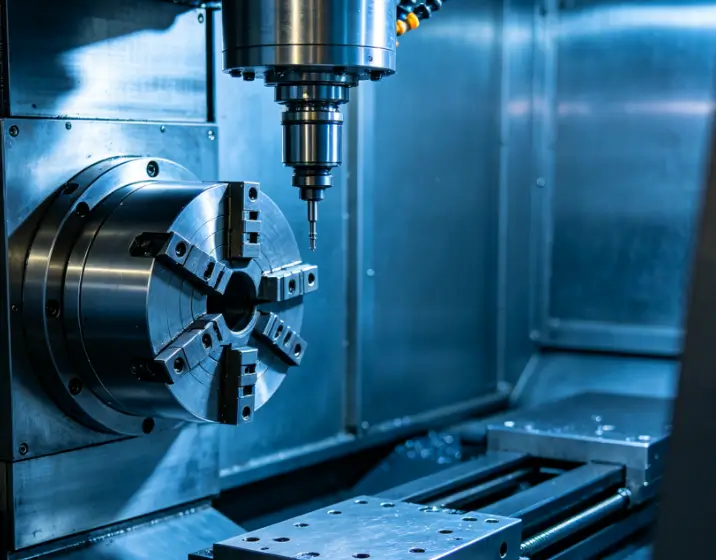
The spindle system serves as the "heart" of a turning-milling hybrid machining center, directly determining machining accuracy, cutting efficiency, and surface quality. It primarily consists of two components: the workpiece spindle (main spindle) and the tool spindle (power tool turret/electric spindle). The main spindle holds the workpiece and rotates it to perform turning operations, while the tool spindle drives the cutting tools to execute milling, drilling, and other machining tasks. These two components work in synergy to accomplish complex composite machining processes.
A high-performance spindle system must demonstrate exceptional rigidity, precision, and rotational speed capabilities. Contemporary mainstream CNC turning-milling hybrid machining centers employ electric spindle designs with rotational speeds exceeding 4,500 rpm and torque reaching 143 Nm. Advanced models achieve speeds surpassing 10,000 rpm, fully meeting high-speed machining requirements. These spindles utilize precision bearings and dynamic balancing technology, maintaining runout within 3μm to ensure rotational accuracy and minimize vibration-induced machining errors. Dual-spindle systems enable independent speed control for primary and secondary spindles with synchronized operation, achieving parallel machining precision within 0.005mm tolerance and significantly enhancing production efficiency.
(2) Dota System: Core Platform for Functional Expansion
The tool turret serves as the core component enabling multi-process machining in turning-milling hybrid centers. It primarily functions to mount various cutting tools (turning tools, milling cutters, drills, reamers, etc.) while facilitating rapid tool replacement and precise positioning. Classified by structural design, tool turrets are categorized into power tool turrets and standard tool turrets. Power tool turrets, as the essential configuration of turning-milling hybrid centers, feature independent drive systems that rotate tools to perform milling, drilling, and other machining operations. In contrast, standard tool turrets are limited to turning processes, offering relatively restricted functionality.
Mainstream turning-milling hybrid machining centers typically feature 12-position or 16-position power tool turrets, offering rapid tool change speeds (0.5-1 second per tool), high positioning accuracy, and integrated Y-axis offset functionality with B-axis swivel capabilities. These features enable machining at arbitrary angles, significantly expanding operational versatility. A prime example is Qingluan Fuxing's TCK2100SYY dual-spindle dual-turret machine tool, equipped with a 12-position power tool turret and B-axis linkage mechanism (±110° swivel range), capable of processing complex features such as eccentric holes and inclined threads.
(3) Feeding System: Key Support for Machining Accuracy
The feed system is responsible for driving workpieces or tools to achieve precise linear or rotational motions, directly impacting machining accuracy and surface quality. It primarily consists of components such as feed motors, ball screws, and linear guides. In turning-milling hybrid machining centers, the feed system typically employs servo motor drives paired with precision ball screws and linear guides. This configuration features high positioning accuracy, fast feed speeds, and smooth motion, enabling micron-level precision feeding to meet stringent high-precision machining requirements.
Linear guides are categorized into rigid rails and linear rails. Rigid rails feature high rigidity and load-bearing capacity, making them ideal for heavy cutting operations and high-precision machining. Linear rails, on the other hand, offer flexible motion and low friction coefficients, suitable for high-speed and light cutting processes. High-end turning-milling hybrid machining centers predominantly employ rigid rail Y-axis power tool turrets. These systems ensure uniform force distribution during milling, smoother trajectory paths for complex surface machining, and superior surface finish quality. Additionally, the integrated 45-degree inclined bed casting design facilitates efficient chip evacuation, maintains excellent rigidity, and prevents vibrations during heavy cutting operations, thereby enhancing feed system stability.
(4) CNC System: The "Brain" of Equipment
The numerical control (NC) system serves as the "brain" of a turning-milling hybrid machining center, orchestrating the entire machining process—including spindle rotation, tool movement, and process switching. Its performance directly determines the equipment's machining accuracy, efficiency, and operational convenience. Currently, NC systems for such machines are primarily categorized into imported and domestic solutions. Imported systems, represented by German Siemens, Japanese FANUC, and Mitsubishi, offer high stability and robust functionality, making them ideal for high-end precision machining. Domestic systems, led by Huazhong CNC, Guangzhou CNC, and Kaidi, provide excellent cost-performance ratios with continuously upgraded features, gradually replacing imported counterparts while meeting mid-to-low-end machining demands.
The CNC system of high-end turning-milling hybrid machining centers features multi-axis coordinated control, automatic programming, error compensation, and real-time monitoring capabilities. It supports advanced CAM software for generating complex turning-milling programs while integrating AI-driven control technology that automatically optimizes processing parameters, diagnoses malfunctions, and achieves closed-loop machining with "self-awareness, autonomous decision-making, and self-regulated control." For instance, Qingluan Fuxing's five-axis integrated turning-milling machine tool is equipped with an AI-powered CNC system powered by DeepSeek's large-scale model, incorporating nearly 100,000 cross-industry machining datasets to automatically generate optimal hybrid processing solutions and simplify operational complexity.
(5) Bed structure: Foundation for equipment stability
The bed is the foundational component of a lathe-milling hybrid machining center, housing all core parts. Its rigidity, stability, and precision directly determine the equipment's machining performance. High-quality beds are constructed from high-strength cast iron or welded steel plates, undergoing aging treatment (natural or artificial aging) to eliminate internal stresses, minimize deformation, and ensure long-term stability. Additionally, rational structural designs such as 45-degree inclined beds and gantry structures enhance rigidity and vibration resistance, reducing machining vibrations to maintain processing accuracy.
For instance, the TCK70Y-1000 heavy-duty dual-spindle lathe-milling hybrid machine from Qingluan Fuxing features an inverted T-shaped moving column layout and high-rigidity bed design. Its 6.5-ton heavy-duty platform ensures stable machining performance, effortlessly meeting complex processing requirements for heavy components such as wind turbine gearbox parts and large bearing housings. Equipped with an intelligent temperature control system, it maintains spindle thermal expansion error within ±1μm and achieves continuous machining precision fluctuations of ≤0.003mm over 8 hours, surpassing the German VDI3441 standard.
IV. Application Fields of Lathe-Fracture Composite Machining Centers: Covering High-End Manufacturing Across Multiple Industries
With their high efficiency, precision, and complex machining capabilities, lathe-milling hybrid machining centers have been widely adopted in high-end manufacturing sectors such as aerospace, automotive production, medical devices, precision instruments, mold manufacturing, and new energy applications. These machines have become essential equipment for technological upgrades and enhanced product competitiveness across industries. Below is a detailed analysis of their primary application fields:
(1) Aerospace Field: Core Equipment for High-End Precision Part Machining
The aerospace industry imposes stringent requirements on component precision, reliability, and safety, with parts often featuring complex irregular geometries and utilizing challenging materials like titanium alloys and high-temperature alloys. Conventional machining methods prove inadequate for such demands, making turning-milling hybrid machining centers the preferred solution. These systems are extensively applied in manufacturing critical components including engine blades, impellers, rotor disks, landing gear parts, hydraulic valve blocks, and aerospace fuel pump housings. By enabling multi-step machining through single-stage clamping with micron-level precision control, they significantly enhance product yield rates and production efficiency.
For instance, the ten-axis five-axis synchronized turning-milling hybrid center developed by Hongyun Lai achieves a precision of 0.005 millimeters and has been successfully applied to the processing of Long March 5 rocket fuel pump bodies. The turning-milling hybrid equipment from Bei Yi Machine Tool is utilized for aerospace component manufacturing, with a first-time acceptance pass rate of 98%. Qingluan Fuxing's five-axis synchronized turning-milling hybrid machine tool enables one-time clamping and forming of precision parts such as aeroengine impellers and root flange slots, maintaining surface profile tolerance within 0.02mm while reducing production cycles by 60% compared to traditional methods.
(II) Automotive Manufacturing Sector: Critical Support for Batch Efficient Processing
The automotive manufacturing industry operates on mass production principles, demanding high processing efficiency and product consistency. Turning-milling hybrid machining centers are primarily utilized for manufacturing critical components such as engine blocks, transmissions, and chassis structures—including turbocharger housings, transmission gear shafts, fuel injectors, drive shafts, and battery enclosures. Dual-spindle turning-milling hybrid systems leverage parallel processing capabilities to significantly enhance production efficiency while maintaining part consistency and reducing defect rates. This technological advancement enables automakers to effectively lower production costs and improve product quality standards.
For instance, Qingluan Fuxing's TCK2100SYY series dual-spindle turning-milling hybrid equipment delivers automated solutions for automotive reducer manufacturers, achieving a 50% increase in core component processing efficiency and reducing defect rates from 3% to 0.8%, successfully supporting major automakers. In the new energy vehicle sector, this equipment provides batch processing solutions for battery casings and drive shafts, with processing efficiency exceeding three times that of traditional single-machine operations while lowering defect rates from 12% to 4%.
 Email
Email sales1: +86 15312799623