



Heavy Duty Slant Bed CNC Lathe for Mass Production
For manufacturers producing large quantities of precision metal components, maintaining consistent machining quality and reducing downtime are essential. Automotive parts, hydraulic components, and industrial machinery parts often require stable turning performance over repeated production cycles.
A heavy-duty slant bed CNC lathe is well suited for mass production when its rigid structure, spindle torque, turret system, chip evacuation, and automation options match the workpiece and production requirements. These features help support repeatable machining, efficient material handling, and reliable operation under demanding cutting conditions.
This article explains the key advantages of heavy-duty slant bed CNC lathes, their applications, and the important factors to consider when selecting a machine for high-volume production.
Why Choose a Heavy-Duty Slant Bed CNC Lathe for Mass Production?
Heavy-duty slant bed CNC lathes are designed to support demanding turning operations through rigid machine construction, suitable spindle systems, and efficient chip management.
Compared with smaller, light-duty turning machines, appropriately configured heavy-duty models can accommodate greater cutting forces and larger workpieces.
Their main advantages include:
- Machining Stability: Rigid construction helps control vibration and workpiece deflection.
- Consistent Production: Reliable spindle and feed systems support repeatable turning operations.
- Efficient Chip Removal: The inclined bed helps direct chips and coolant away from the cutting area.
- Automatic Tool Changing: Hydraulic or servo turrets reduce manual intervention between operations.
- Automation Flexibility: Compatible loading systems can reduce repetitive handling tasks.
However, the slant bed design alone does not guarantee higher precision or productivity. Actual performance depends on machine specifications, tooling, workholding, and cutting conditions.
Slant Bed Structure, Rigidity, and Chip Evacuation
Rigid Structure for Heavy-Duty Turning
The inclined bed is one of the defining structural features of a slant bed CNC lathe.
Many industrial models use rigid cast-iron structures designed to support the spindle, turret, and linear-motion components under cutting loads.
A properly designed machine structure helps reduce unwanted vibration and maintain stable cutting conditions.
For heavy-duty turning, overall machine rigidity is especially important when machining steel, stainless steel, and other materials that generate substantial cutting forces.
Some machines also undergo stress-relief treatments to help reduce residual casting stresses and improve dimensional stability.
The effectiveness of these features depends on the complete machine design, not simply the bed angle or casting weight.
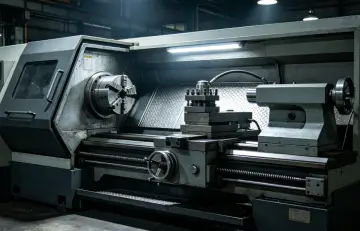
Efficient Chip Evacuation
Chip removal is important during repeated turning operations, particularly when machining materials that produce long or continuous chips.
The inclined bed helps guide chips and coolant toward the machine's collection area.
When combined with an appropriate chip conveyor and coolant system, this arrangement can:
- Reduce chip accumulation near the cutting zone.
- Improve chip and coolant management.
- Reduce cleaning-related production interruptions.
- Support more consistent machining conditions.
Nevertheless, chip evacuation performance still depends on chip formation, cutting parameters, coolant delivery, and conveyor design.
Proper inspection and maintenance remain necessary during continuous production.
Spindle, Turret, and Precision for Continuous Production
High-Torque Spindle Performance
Heavy-duty turning often requires sufficient spindle torque to maintain stable cutting under demanding conditions.
A suitable spindle system allows the machine to perform roughing and finishing operations according to the material and workpiece requirements.
When selecting equipment, manufacturers should evaluate spindle power, torque characteristics, speed range, and workholding capacity.
For heavy cutting, available torque at the required spindle speed is often more important than maximum spindle speed alone.
Automatic Turret and Tooling Options
Hydraulic and servo-driven turrets enable automatic tool indexing between turning operations.
Depending on the machine configuration, the turret can accommodate tools for turning, grooving, threading, drilling, and boring.
Some slant bed CNC lathes also offer driven tooling and C-axis functions for additional machining operations.
These options may reduce the need to transfer suitable components to another machine.
However, driven tooling and C-axis capability should be confirmed as available features rather than assumed to be standard.
Maintaining Machining Consistency
Repeatable accuracy during mass production depends on several factors:
- Spindle and axis condition
- Tool wear and offset management
- Machine rigidity and thermal behavior
- Workpiece clamping and alignment
- Cutting parameters and coolant control
Regular inspection and preventive maintenance help maintain machining consistency over repeated production cycles.
Automation Options for High-Volume CNC Turning
Automation can improve productivity by reducing manual loading, unloading, and handling time.
Depending on the machine configuration, heavy-duty slant bed CNC lathes may support:
Automatic Bar Feeders
Suitable for compatible bar-stock components, allowing material to be advanced automatically between machining cycles.
Robotic Loading and Unloading
Can reduce repetitive handling tasks for production parts when properly integrated with the machine and workholding system.
Part Collection Systems
Help organize finished components and support continuous production workflows.
Production Monitoring
Compatible CNC systems and additional monitoring equipment may provide operating data, alarms, and production information for maintenance and production management.
For high-volume manufacturing, these functions can improve equipment utilization and reduce non-cutting time.
However, automated production is not the same as safely unattended production. Unattended operation requires suitable monitoring, risk assessment, machine safeguards, and process-specific safety measures.
Typical Applications of Heavy-Duty Slant Bed CNC Lathes
Heavy-duty slant bed CNC lathes are used in industries requiring stable turning performance and repeatable part quality.
| Industry | Typical Machined Components |
|---|---|
| Automotive Manufacturing | Drive shafts, sleeves, hubs, and gear blanks |
| Hydraulic and Pneumatic Equipment | Piston components, valve parts, and hydraulic fittings |
| Engineering Machinery | Shafts, bushings, and mechanical connectors |
| Energy Equipment | Suitable flanges, couplings, and threaded components |
| General Precision Manufacturing | Custom rotational parts and batch-produced metal components |
Their suitability depends on the actual machine's turning diameter, maximum machining length, spindle capacity, and workholding system.
For especially long or oversized components, a specialized heavy-duty horizontal or vertical lathe may be more appropriate.
How to Choose the Right Slant Bed CNC Lathe for Mass Production
Manufacturers should evaluate machine performance according to the parts they need to produce rather than relying only on general descriptions such as high rigidity or heavy duty.
| Selection Factor | What to Check |
|---|---|
| Turning Capacity | Maximum turning diameter and machining length |
| Spindle Performance | Power, torque, speed range, and spindle bore |
| Workholding | Chuck size, permitted workpiece weight, and support options |
| Turret Configuration | Tool positions, indexing method, and driven-tool compatibility |
| Guideway and Feed System | Rigidity, load capacity, and positioning performance |
| Chip Evacuation | Coolant delivery, chip control, and conveyor options |
| Automation | Bar feeders, robotic loading, and production monitoring compatibility |
| Maintenance | Spare parts, service support, and preventive maintenance requirements |
For mass production, overall productivity should be assessed through actual cycle time, setup time, tool life, part quality, and equipment availability.
A machine with higher power or more automation is not necessarily the best choice if those capabilities are unnecessary for the intended workpieces.
Frequently Asked Questions
Q1:What Makes a Slant Bed CNC Lathe Suitable for Mass Production?
A:A rigid machine structure, suitable spindle and turret systems, efficient chip evacuation, and compatible automation can support repeatable turning operations. Actual productivity depends on workpiece requirements, machining parameters, and production management.
Q2:Can a Heavy-Duty Slant Bed CNC Lathe Operate Continuously?
A:Heavy-duty CNC lathes can support extended production schedules when properly specified, operated, and maintained. However, continuous operation does not mean maintenance-free or guaranteed fault-free performance. Tool inspection, lubrication, monitoring, and scheduled maintenance remain necessary.
Q3:Is a Slant Bed CNC Lathe Better Than a Flat Bed Lathe?
A:A slant bed CNC lathe can offer advantages in chip evacuation, compact tool arrangements, and automated production. However, a well-designed flat bed lathe may be more suitable for certain long workpieces or specialized turning tasks. The best choice depends on the component and machining requirements.
Conclusion
A heavy-duty slant bed CNC lathe can be an effective solution for mass production of precision metal components.
Its rigid construction, efficient chip management, automatic turret, and potential automation options help support stable turning operations and reduce unnecessary handling.
For manufacturers producing automotive parts, hydraulic components, and industrial machinery parts, the most important consideration is selecting a machine that matches the required cutting loads, workpiece dimensions, accuracy, and production volume.
MINNUO provides CNC machine tool solutions for different industrial turning applications. Choosing the appropriate machine configuration helps manufacturers build more consistent and efficient production processes.

 Email
 sales1: +86 15312799623