



How to Choose a Slant Bed CNC Lathe: Workpiece Size, Torque & Production Capacity
Choosing the right slant bed CNC lathe requires more than comparing machine specifications and purchase prices. Machine shop owners need to evaluate workpiece dimensions, material properties, spindle torque, machining accuracy, tooling configurations, and actual production capacity.
The most effective approach is to confirm the machine's usable machining envelope, verify its continuous cutting capability, assess the required tooling and automation features, and validate performance through machining tests.
This guide explains how to select a slant bed CNC lathe for your production requirements, compares representative CNC turning centers from Haas, Okuma, and Mazak, and outlines the inspection criteria that matter when purchasing new or used equipment.
1. What Are the Costs of Choosing the Wrong Slant Bed CNC Lathe?
1.1 Why Is Maximum Swing Diameter Different from Maximum Turning Diameter?
Maximum swing diameter refers to the largest workpiece diameter that can rotate within a specified area of the machine.
Maximum turning diameter refers to the largest diameter the machine can actually machine with a particular tooling configuration.
These specifications are not interchangeable.
For example, the published specifications of the Haas ST-20 include:
| Specification | Value |
|---|---|
| Maximum Workpiece Swing | 533 mm |
| Maximum Turning Diameter (BOT Turret) | 330 mm |
| Maximum Turning Diameter (BMT65 Turret) | 298 mm |
| Maximum Turning Diameter (VDI Turret) | 300 mm |
| Maximum Turning Length | 572 mm, depending on workholding configuration |
Source: Haas ST-20 Official Specifications.
A CNC lathe with a maximum swing diameter of 533 mm cannot necessarily turn a workpiece with a diameter of 500 mm.
The actual machining envelope also depends on the chuck, soft jaws, turret, tool overhang, and tailstock position.
Before purchasing a machine, request a machining envelope drawing and verify tool clearance for your largest workpiece and most demanding machining operation.
1.2 Why Don't Maximum Spindle Speed and Peak Power Tell the Whole Story?
Different materials and machining operations require different spindle characteristics.
Small-diameter aluminum components often require higher spindle speeds. Heavy rough turning of large-diameter alloy steel components generally places greater demands on continuous torque at lower speeds.
The theoretical relationship between spindle power, speed, and torque is:
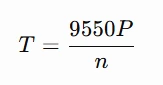
Where:
- T= Spindle torque, N·m
- P= Power delivered at the spindle, kW
- n = Spindle speed, rpm
Suppose a spindle can continuously deliver 15 kW at 500 rpm.
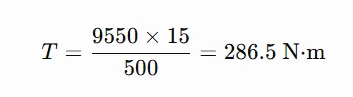
The corresponding theoretical torque is approximately 286.5 N·m.
However, whether the spindle can maintain 15 kW at 500 rpm depends on the motor characteristics, transmission system, and spindle power-torque curve.
A machine's maximum rated power cannot simply be substituted into this formula at any spindle speed to determine its actual available torque.
Buying recommendation: Ask the supplier for continuous power, short-term rated power, continuous torque, and the complete spindle power-torque curve. Verify these specifications against your most demanding cutting operation.
1.3 How Can You Calculate Actual Good-Part Output per Shift?
The theoretical cycle time listed in a machine specification does not necessarily represent actual production output.
Real manufacturing involves loading and unloading, tool changes, equipment downtime, operating-speed losses, and rejected parts.
When cycle time represents the ideal cycle time and Overall Equipment Effectiveness (OEE) includes availability, performance, and quality, good-part output can be estimated using:
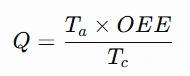
Where:
- Q= Good parts produced per shift
- Ta= Planned production time, minutes
- OEE= Overall Equipment Effectiveness
- Tc= Ideal cycle time per part, minutes
OEE is calculated as:

Because OEE already includes the quality rate, good-part output should not be multiplied by the quality rate again.
Consider a machine shop operating one production shift:
| Parameter | Assumed Value |
|---|---|
| Planned Production Time | 480 minutes |
| Ideal Cycle Time | 8 minutes |
| OEE | 65% |
| Annual Operating Days | 250 |
Theoretical production:

Estimated good-part output:

Under these assumptions, the machine's theoretical output is 60 parts per shift, while its estimated good-part output is 39 parts per shift at 65% OEE.
The difference highlights why theoretical cycle time alone is insufficient for evaluating CNC lathe productivity. Machine availability, operating efficiency, and quality losses must also be considered when estimating actual production capacity.
If the contribution margin is assumed to be $120 per part, the annual contribution margin associated with the capacity gap would be:

This is an illustrative opportunity-value calculation, not a verified financial loss.
The additional contribution margin could only be realized if sufficient customer demand exists, the additional capacity can be sold, and no other production bottlenecks prevent the extra output.
If actual average cycle time or production time already accounts for downtime or performance losses, the calculation must be adjusted to avoid double-counting those losses.
2. What Workpiece Information Is Needed Before Selecting a Slant Bed CNC Lathe?
2.1 How Should You Determine the Required Machine Size?
Before purchasing a CNC lathe, evaluate both your current workpieces and expected future production requirements.
Do not select a machine based only on the largest component in your workshop.
A practical approach is to divide workpieces into three groups:
- P50 workpieces: The median of the workpiece size distribution, representing typical machining requirements.
- P90 workpieces: The 90th percentile of the workpiece size distribution, helping identify the machining envelope needed for most jobs.
- Extreme workpieces: The largest or most demanding components the machine is expected to process.
The following information should be collected:
| Workpiece Parameter | Required Information | Impact on Machine Selection |
|---|---|---|
| Maximum Blank Diameter | Largest diameter before machining | Swing capacity and chuck size |
| Maximum Finished Diameter | Largest diameter requiring turning | Maximum turning diameter |
| Overall Workpiece Length | Includes clamping and machining sections | Z-axis travel and tailstock clearance |
| Workpiece Weight | Total blank weight | Spindle, chuck, and load capacity |
| Length-to-Diameter Ratio | Workpiece length relative to diameter | Tailstock and steady-rest requirements |
| Material and Hardness | Steel, aluminum, stainless steel, cast iron, etc. | Spindle torque and tooling |
| Internal Features | Bore diameter, depth, and tolerance | Boring bar clearance and rigidity |
| Machining Tolerances | Dimensional and geometric tolerances | Accuracy and thermal stability |
| Monthly Production Volume | Quantity and batch size | Automation and cycle-time requirements |
For high-mix, low-volume machine shops, setup frequency and programming time should also be considered.
Purchasing a large CNC lathe for a small number of oversized components may increase capital investment, floor-space requirements, and operating costs.
Conversely, selecting a machine that only meets current requirements may limit future production if confirmed projects require larger or more complex components.
2.2 How Do You Calculate Spindle Speed Based on Workpiece Diameter and Material?
The required spindle speed for a turning operation can be calculated using cutting speed and workpiece diameter:
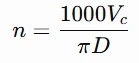
Where:
- n= Spindle speed, rpm
- Vc= Cutting speed, m/min
- D= Machining diameter, mm
Consider two illustrative machining conditions:
| Machining Operation | Diameter | Assumed Cutting Speed | Calculated Spindle Speed |
|---|---|---|---|
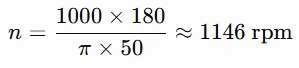
| Steel External Turning | 50 mm | 180 m/min | 1,146 rpm |
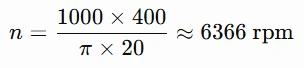
| Aluminum External Turning | 20 mm | 400 m/min | 6,366 rpm |
For a 50 mm steel component:
For a 20 mm aluminum component:
These cutting speeds are illustrative assumptions, not universal recommendations for all steel or aluminum grades.
Actual cutting speed depends on material grade, hardness, insert material, coating, depth of cut, and coolant conditions.
For small-diameter, high-speed machining, verify the maximum spindle speed. For large-diameter, heavy-duty turning, focus on continuous low-speed torque and machine rigidity.
In constant surface speed mode, the required spindle speed increases as the cutting diameter decreases. An appropriate maximum spindle speed limit should therefore be programmed, especially when using large chucks, eccentric workpieces, or workholding with speed restrictions.
3. How Do Haas, Okuma, and Mazak CNC Turning Centers Compare?
Different CNC lathe manufacturers use different spindle power ratings, turret configurations, and machine specifications.
Comparing machine specifications helps buyers understand technical differences, but it should not be used to declare one brand universally superior.
3.1 Comparing Machining Capacity and Spindle Specifications
| Specification | Haas ST-20 | Okuma GENOS L3000-e | Mazak QUICK TURN 200 |
|---|---|---|---|
| Maximum Turning Diameter | 330 mm (BOT) | 340 mm | Approx. 356 mm |
| Maximum Turning Length | 572 mm* | 500 mm | Approx. 508 mm |
| Maximum Spindle Speed | 4,000 rpm | 3,800 rpm | 5,000 rpm |
| Maximum / Short-Term Power | 14.9 kW | 22 kW | 26 kW |
| Continuous Power | Not separately listed | 15 kW | Not disclosed |
| Maximum / Short-Term Torque | 203 N·m | 412 N·m | Not disclosed |
| Continuous Torque | Not separately listed | 281 N·m | Not disclosed |
| Turret Stations | 12 | 12 | 12 |
Haas turning length depends on the workholding configuration. Okuma figures refer to the referenced 500 mm version. Mazak figures refer to the referenced U.S. 2EKY configuration.
Power and torque ratings are not directly comparable because their duty ratings, configurations, and test conditions differ.
Sources:
- Haas ST-20 Official Specifications
- Okuma GENOS L3000-e
- Mazak QUICK TURN 200
The Haas ST-20, Okuma GENOS L3000-e, and Mazak QUICK TURN 200 represent different machine configurations and design priorities.
For machine shops specializing in heavy alloy steel roughing, continuous low-speed torque and structural rigidity may be more important than maximum spindle speed.
For small precision components or high-speed aluminum machining, spindle speed, thermal stability, tooling systems, and setup efficiency may be more important.
3.2 Which Specifications Must Be Standardized When Comparing CNC Lathes?
At minimum, compare machines using the same evaluation criteria:
- Complete machine model, spindle configuration, and bed length.
- Peak, short-term, and continuous power ratings.
- Spindle torque at relevant operating speeds.
- Turret configuration associated with maximum turning diameter.
- Chuck, tailstock, and workholding conditions associated with maximum turning length.
- Material, tooling, depth of cut, and coolant conditions used during cutting tests.
A specification comparison is only meaningful when the relevant operating conditions and configurations are understood.
4. What Are the Four Key Factors When Selecting a Slant Bed CNC Lathe?
4.1 Can the Machine Handle Your Most Demanding Workpiece?
The first step is to confirm whether the machine can complete the most demanding machining operation without interference.
Check the chuck capacity, X/Z-axis travel, tool overhang, turret clearance, tailstock position, and chip evacuation space.
For long shaft components, evaluate deflection, vibration, and the effectiveness of tailstock or steady-rest support.
4.2 Are Continuous Power and Low-Speed Torque Sufficient?
If your workshop primarily machines stainless steel, alloy steel, or forged components with large machining allowances, focus on the cutting load during the most demanding operation.
Evaluation should consider cutting speed, feed rate, depth of cut, specific cutting force, and transmission efficiency.
A higher spindle power rating does not automatically mean better heavy-cutting performance.
4.3 Are Y-Axis, Live Tooling, and Sub-Spindle Options Worth the Investment?
Different machine configurations offer different production benefits.
| Configuration | Main Function | Typical Application |
|---|---|---|
| Live Tooling | Drilling, tapping, and certain milling operations | Parts requiring additional machining within one setup |
| Y-Axis | Off-center machining and complex mill-turn features | Eccentric holes, offset slots, and complex geometries |
| Sub-Spindle | Workpiece transfer and back-side machining | Parts requiring machining on both ends |
| Automatic Bar Feeder | Continuous bar-stock loading | Repetitive production of bar-stock components |


More features do not automatically produce a better return on investment.
If most jobs involve simple external turning, facing, and boring, advanced mill-turn capabilities may increase purchase, programming, and maintenance costs without providing sufficient benefits.
Additional options should be justified by measurable reductions in setup time, machining operations, labor requirements, or positioning errors.
4.4 Can the Machine Meet Your Actual Good-Part Production Target?
Production capacity should be evaluated using realistic cycle times and factory OEE rather than rapid traverse speeds or theoretical machining times alone.
For high-volume production, ask the supplier to conduct continuous cutting tests using specified workpieces, materials, tools, and fixtures.
For high-mix, low-volume manufacturing, also record setup time, programming time, first-piece inspection, and tool preparation.
These factors can significantly affect actual delivery performance.
4.5 Which Workpieces May Not Be Suitable for a Slant Bed CNC Lathe?
Slant bed designs generally support efficient chip evacuation, compact machine layouts, and automation integration.
However, they are not automatically the best choice for every turning application.
Extremely long shafts, very heavy workpieces, oversized low-speed components, or parts requiring specialized support may be better suited to heavy-duty flat bed lathes, vertical turning centers, or other specialized machine configurations.
The final decision should be based on workpiece geometry, cutting loads, machining accuracy, and overall economics rather than bed angle alone.
5. How Should You Inspect a Slant Bed CNC Lathe During FAT and SAT?
5.1 Which Accuracy and Production Parameters Should Be Tested?
Factory Acceptance Testing (FAT) is performed before the machine leaves the supplier's facility.
Site Acceptance Testing (SAT) is conducted after installation at the customer's factory.
For machine shops, the following items should be included in the acceptance agreement:
| Inspection Item | Test Requirements | Recorded Results |
|---|---|---|
| Geometric Accuracy | Axis straightness, perpendicularity, and other applicable tests | Measured deviations |
| Positioning Accuracy | X/Z-axis positioning and repeatability | μm |
| Spindle Thermal Deformation | Cold-start to thermal stabilization | Displacement-time curve |
| Roundness and Cylindricity | Machining and measuring specified test pieces | μm |
| Surface Roughness | Specified workpiece and cutting conditions | Ra, Rz |
| Continuous Production | Extended machining of specified components | Cycle time and good-part rate |
| Machine Load | Representative roughing and finishing operations | Power and spindle load |
| Utilities | Compressed air and electricity | MPa, m³/h, kW |
| Process Capability | Samples from stable production | Cp, Cpk |
The acceptance agreement should specify environmental conditions, measuring instruments, sample sizes, allowable tolerances, and acceptance criteria.
For example, a controller with a minimum command increment of 1 μm does not guarantee that the machine can consistently produce parts with a 20 μm dimensional tolerance.
Actual machining accuracy is affected by thermal deformation, tool wear, clamping deformation, ambient temperature, and measurement-system capability.
5.2 What Do ISO 13041-1 and ISO 13041-6 Cover?
ISO 13041-1:2020 addresses geometric accuracy testing for numerically controlled turning machines and turning centers with horizontal spindles.
It does not replace a complete production-performance acceptance test and does not cover every vibration, noise, or feed-performance issue.
ISO 13041-6:2009 addresses machining tests using standardized test pieces under finishing conditions.
Therefore, standardized test-piece inspection should be combined with acceptance tests using the customer's actual components.
For precision machining applications, continuous cutting tests should use specified materials, fixtures, tools, and production conditions, with original inspection records retained.
6. How Much Can Automation Improve CNC Turning Center Productivity?
6.1 Case Study: Daily Output Increased from 100 to 250 Parts
A published Okuma case study involving Mach Machine reports that the original process produced approximately 100 parts per day.
After production was transferred to an Okuma LB3000 EX equipped with an automatic gantry loading system, daily output increased to approximately 250 parts.
The reported production increase is:
(250-100)/100×100%=150%
Source: Okuma Mach Machine Case Study.
This example primarily demonstrates the potential benefits of automated loading and improved production organization.
It does not prove that slant bed geometry alone increases productivity by 150%, nor does it imply that every machine shop will achieve the same improvement.
6.2 How Do You Calculate Annual Production Gains and Payback Period?
Assuming 250 operating days per year:
(250-100)×250=37,500additional parts/year
Under the assumption that the daily production difference remains consistent, annual output could increase by 37,500 parts.
This is an annualized scenario based on published daily production figures, not a documented 12-month production result.
Actual financial benefits also depend on additional customer demand, good-part yield, labor, tooling, maintenance, and energy costs.
For projects with relatively stable annual net cash benefits, a simplified static payback calculation can be used:
Simple Payback Period= Initial Investment÷Annual Incremental Net Cash Benefit
Initial investment should include the machine, automation equipment, fixtures, tooling, installation, and implementation costs.
Annual incremental net cash benefit should account for additional contribution, cost savings, increased operating expenses, and other relevant cash expenditures.
This simplified calculation does not account for the time value of money.
For projects with irregular cash flows, the payback period should be determined using cumulative net cash flow. Larger or longer-term investments should also be evaluated using Net Present Value (NPV) and Internal Rate of Return (IRR).
If annual incremental net cash benefit is zero or negative, the simplified formula does not produce a meaningful positive payback period.
6.3 Why Is Cost per Good Part More Important Than Machine Purchase Price?
For machine shops operating CNC equipment over many years, the purchase price represents only one component of total production cost.
Cost per good part can be calculated as:
Cost per Good Part= Total Relevant Production Costs÷Number of Good Parts Produced
Relevant costs may include machine depreciation, labor, tooling, electricity, maintenance, consumables, and appropriately allocated production overhead.
Two CNC lathes with significantly different purchase prices may have very different long-term operating costs because of differences in cycle time, scrap rates, downtime, and maintenance requirements.
Therefore, the economic comparison should focus on the total cost of producing each acceptable component rather than the initial machine quotation alone.
7. Frequently Asked Questions About Slant Bed CNC Lathes
Q:How Much Larger Should the Maximum Turning Diameter Be Than the Workpiece?
A:There is no universal safety-margin percentage. The required clearance depends on blank eccentricity, soft jaws, tool paths, turret movement, tailstock position, and chip evacuation space. A machining interference check should be performed for the most demanding operation.
Q:When Does a Long Workpiece Require a Tailstock or Steady Rest?
A:The decision depends on the workpiece's length-to-diameter ratio, material stiffness, cutting forces, clamping length, spindle speed, and geometric tolerances. Actual cutting tests should be used to confirm whether additional support is required.
Q:Is a 5,000 rpm CNC Lathe Always Better Than a 3,800 rpm Machine?
A:No. Small-diameter components may benefit from higher spindle speeds, while heavy turning of large-diameter workpieces often depends more on continuous low-speed torque, machine rigidity, and thermal stability. Maximum spindle speed is only one selection factor.
Q:When Should a Machine Shop Invest in Y-Axis and Live Tooling?
A:Y-axis and live tooling become more valuable when parts require off-center holes, slots, milling features, or secondary setups. The investment should be justified by measurable savings in setup time, labor, work-in-process, and positioning errors.
Q:How Should CNC Lathe Production Capacity Be Defined in an Acceptance Agreement?
A:The agreement should specify the workpiece, material, tooling, fixtures, cycle time, good-part rate, continuous operating duration, tool-change time, operator interventions, and good parts produced per shift. Theoretical cycle time alone is not sufficient.
8. Final Checklist: How Should a Machine Shop Make Its CNC Lathe Purchase Decision?
A practical CNC lathe selection process should follow four steps.
Step 1: Confirm Workpiece Requirements
Identify the maximum blank diameter, machining length, workpiece weight, workholding requirements, and interference clearance.
Step 2: Verify Cutting Capability
Evaluate material requirements, spindle speed, continuous power, low-speed torque, and structural rigidity.
Step 3: Evaluate Accuracy and Configuration
Confirm turret configuration, Y-axis requirements, tailstock options, thermal stability, and acceptance criteria.
Step 4: Validate Productivity and Return on Investment
Compare good-part output, OEE, cost per part, operating expenses, and investment payback.
The final purchasing decision should be based on actual machining tests, verifiable machine specifications, and long-term production economics.
For machine shops considering a used slant bed CNC lathe, additional inspections should include operating hours, spindle condition, guideway and ballscrew wear, geometric accuracy, maintenance history, and CNC control system condition.
A lower initial purchase price does not necessarily mean a lower total cost of ownership. Thorough inspection and production testing can help reduce the risk of unexpected repairs, accuracy problems, and unplanned downtime.
 Email
Email sales1: +86 15312799623