



Selection and Practical Guide for Desktop Miniature CNC Lathe: Unlocking New Possibilities of Precision Machining with Compact Size
In the current era of manufacturing transformation toward intelligence and flexibility, not all processing scenarios require large-scale industrial machine tools. For university maker labs, small-batch production in SMEs, vocational training programs, and sample processing in research institutions, compact table-mounted CNC lathes have emerged as essential equipment for "precision machining of small components." With their space-efficient design, user-friendly operation, and high-precision performance, these lathes outperform traditional large CNC machines by eliminating the need for extensive workshop space and specialized high-voltage power supply. They effectively meet precision machining requirements while controlling procurement and operational costs, gradually becoming indispensable equipment for niche processing applications.
This article focuses on desktop-type small CNC lathes (using mainstream models like CK140 and CMK0220II as examples), steering clear of broad topics such as "the development of the CNC machine tool industry." Starting from practical application scenarios, it provides a detailed analysis of core advantages, selection techniques, operational essentials, common troubleshooting methods, and maintenance approaches. Designed to assist users with small-batch, high-precision machining needs, the content helps them quickly select and effectively utilize equipment, fully realizing the value of "compact size with powerful performance." Additionally, it addresses common selection misconceptions and operational challenges in the industry, offering actionable insights for professionals.
I. Cognitive Upgrade: Desktop Miniature CNC Lathe is More Than a 'Miniature' Machine Tool
Many users hold misconceptions about desktop-type small CNC lathes, mistakenly viewing them as mere "miniature versions" of larger CNC lathes with significantly reduced performance and precision. In reality, these compact lathes are specifically engineered for small-scale part machining scenarios, prioritizing "precise customization and operational efficiency" over simple size reduction. While retaining the core functionalities of CNC lathes, they optimize compact dimensions, energy efficiency, and user accessibility, making them particularly well-suited for niche machining applications.
1.1 Core Definitions and Application Scenarios (Precise Matching of Search Requirements)
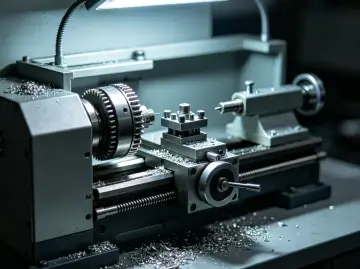
The desktop compact CNC lathe is a space-efficient CNC machining equipment powered by 220V household electricity, designed for placement on workbenches or small tables. Primarily used for processing precision components with diameters ≤210mm and lengths ≤300mm, it performs comprehensive operations including external cylindrical turning, drilling, tapping, boring, thread turning, slotting, and cutting. With highly specialized applications, this equipment primarily serves four key industrial sectors that currently represent the most concentrated market demand.
The first scenario involves university and vocational college settings: Ideal for processing functional components of creative products in maker labs and innovation studios, as well as initial prototype fabrication and integrated theory-practice training in CNC programs. This approach not only meets students' creative production needs but also aligns with practical training requirements that bridge theoretical knowledge and hands-on application. When paired with supplementary video tutorials and printed materials, it enables students to swiftly master CNC operation techniques.
The second scenario involves small and medium-sized enterprises (SMEs) and startups: Designed for small-batch, multi-variety processing needs such as small components in electronics, telecommunications, and home appliance industries, as well as micro parts for automobiles and motorcycles. Without requiring large-scale equipment, these solutions enable high-precision machining, significantly reduce production costs, and offer flexible order responsiveness—perfectly aligning with market trends of "diverse product lines, small batches, and rapid delivery."
Third, research institution scenarios: Designed for precision processing of initial plates and samples, the equipment features user-friendly operation and excellent noise reduction performance. It meets the requirements of frequent debugging and small-batch prototyping during scientific research processes, avoiding the cumbersome debugging procedures and large space occupation associated with large-scale equipment, thereby facilitating the rapid commercialization of research outcomes.
Fourth, the maker and personal studio scenario: Ideal for craft enthusiasts and engineers to engage in creative production. It supports processing various materials such as copper, aluminum, plastic, and acrylic glass, with both graphical and manual programming capabilities. No prior programming expertise is required to complete complex part manufacturing, unlocking greater possibilities for creative production.
1.2 Core Differences from Traditional Large CNC Lathe Machines (Targeting User Pain Points)
Many users struggle with equipment selection: "Why choose a compact desktop CNC lathe instead of a larger model?" The key difference lies in "scenario adaptability" rather than performance metrics. Below, we analyze five core dimensions to clearly compare the two options and help users accurately identify their needs.
Dimension 1: Volume and Space Requirements – Desktop-type small CNC lathes typically measure between 750×450×850mm and 1100×750×750mm, occupying only 0.5-1 square meters. They can be directly placed on workbenches or small worktables and even come with casters for easy mobility. In contrast, traditional large CNC lathes usually require over 5-10 square meters of space, necessitating dedicated workshop areas and offering extremely limited deployment flexibility.
Dimension 2: Power Supply and Energy Consumption – Desktop compact CNC lathes operate on standard 220V household electricity, requiring no specialized high-voltage line modifications and compatible with most power supply conditions. With output power ranging from 350W to 1100W, they feature low energy consumption that enables significant electricity savings over extended use. In contrast, traditional large-scale CNC lathes typically demand 380V industrial high-voltage power supply, delivering output power exceeding 5kW, resulting in higher energy consumption and additional costs for line modifications.
Dimension 3: Operational Threshold – Desktop compact CNC lathes are equipped with industrial-grade panel CNC systems (e.g., 980TB systems), supporting both graphical and manual programming while being compatible with various CAD/CAM software. Even beginners can quickly master operation through accompanying textbooks. In contrast, traditional large CNC lathes require complex operation procedures, necessitate specialized CNC operators, involve high programming complexity, and incur substantial training costs.
Dimension 4: Processing Range – Desktop-type small CNC lathes are primarily designed for small components, with rotary diameters typically ranging from 140-210mm and workpiece clamping diameters of 1-80mm, making them ideal for processing small-sized, high-precision parts. In contrast, traditional large CNC lathes are capable of machining oversized, heavy-duty components, featuring rotary diameters exceeding 500mm, and are suitable for mass production of large-scale parts.
Dimension 5: Procurement and Operational Costs – Desktop compact CNC lathes typically cost tens of thousands of yuan, significantly lower than traditional large-scale CNC lathes (which can range from hundreds of thousands to millions of yuan). These compact models feature simplified maintenance procedures, low spare parts costs, and require no specialized maintenance personnel, making them ideal for small and medium-sized enterprises, universities, and makers with limited budgets. In contrast, traditional large CNC lathes entail higher procurement costs, complex maintenance processes, and necessitate professional maintenance teams, resulting in persistently high operational expenses. Such advantages render them more suitable for large manufacturing enterprises.
1.3 Core Advantages: Why Niche Applications Are Better Suited for Desktop Compact CNC Lathe Machines?
Considering the aforementioned application scenarios and comparisons with large-scale equipment, the desktop compact CNC lathe's core advantage lies in its "precision alignment with niche demands." These strengths can be summarized into six key points, each directly addressing user pain points and serving as the key factors that make it the preferred choice for specialized machining applications.
Advantage 1: Precision meets stringent requirements for precision machining. Crafted from premium cast iron and equipped with high-precision ball screw grinding technology, the system achieves a resolution of 0.001mm and repeat positioning accuracy of 0.02mm. This performance satisfies precision demands in electronics, scientific research, and practical training applications. Even complex operations like thread machining and surface processing ensure consistent results, matching the precision of large-scale equipment.
Advantage 2: Flexible deployment and adaptability to multiple scenarios – Compact size and easy mobility eliminate the need for dedicated workshops. It can be effortlessly deployed in university laboratories, small workshops of SMEs, or maker studios. Powered by 220V household voltage without requiring wiring modifications, plug-and-play operation significantly reduces deployment costs and complexity.
Advantage 3: User-friendly operation reduces learning and labor costs – Supports both graphical and manual programming with an electronic handwheel for flexible manual and tooling adjustments. Equipped with graphical simulation capabilities and comprehensive self-diagnostic functions that display real-time anomalies and trigger alarms, ensuring operational safety. Beginners can operate immediately after brief training without requiring specialized CNC technicians, significantly lowering labor costs.
Advantage 4: Strong compatibility for diverse machining needs — Featuring ISO-standard G-code programming with support for M-code and S-code, it fully integrates with FANUC, Mitsubishi G-code systems, and multiple CAD/CAM software (e.g., MasterCAM, UG, SolidWorks, Fusion360). The robust B-class macro parsing capability enables users to develop customized motion control programs effortlessly. Capable of processing a wide range of materials including copper, aluminum, plastics, acrylic glass, steel, and iron, it meets various component manufacturing requirements.
Advantage 5: Safety and Reliability for Peace of Mind – Featuring a fully enclosed structure with transparent plexiglass and metal panels, equipped with door safety mechanisms and internal lighting for enhanced safety and visibility. Certified with EU CE safety standards (IP54 protection rating), it incorporates overload protection, short-circuit protection, and leakage current protection devices that automatically activate during voltage anomalies or short circuits to safeguard personnel and equipment. Ideal for high-security environments such as university training facilities and maker spaces.
Advantage 6: Cost-controlled and outstanding cost-performance ratio – featuring low procurement costs and operational expenses (including energy efficiency and simplified maintenance). The system replaces manual processing, significantly boosting production efficiency and shortening processing cycles. For small-batch manufacturing scenarios, its input-output ratio far exceeds that of large CNC lathes. Some equipment models can be customized with accessories like bases and cooling systems, enabling flexible cost management and eliminating waste caused by redundant functionalities.
II. Selection Guide: 3 Steps to Select the Right Desktop CNC Lathe
Selecting equipment can be confusing due to diverse models and specifications. This 3-step method helps you avoid 90% of common mistakes.
Step 1: Clarify Your Processing Requirements
Answer four core questions:
- Part size: Max diameter and length → match swing diameter and axis travel
- Accuracy: Tolerance and surface roughness → confirm resolution and repeatability
- Materials & processes: Copper, aluminum, steel, plastic; threading, automatic tool change → match spindle power and tool holder
- Scenario & budget: Lab, workshop, studio; fixed or movable → control configuration cost
Step 2: Evaluate Core Mechanical & Electrical Configurations
Focus on these key components to ensure stability and precision:
- Bed structure: High-strength cast iron for rigidity and vibration resistance
- Transmission: Precision ground ball screws for positioning accuracy
- Spindle: High speed, low noise, stable rotation
- Tool holder: 4-station electric tool holder for automatic switching
- Control system: Compatible with standard G-code, easy to program
- Protection: IP54, fully enclosed, safety interlock
Step 3: Verify Brand, Service & After-Sales Support
- Choose manufacturers with mature technology and stable quality
- Prioritize suppliers with training, installation, and troubleshooting services
- Check MTBF (mean time between failures) and spare parts availability
- Prefer models with wide user feedback and mature application cases
Common Selection Misconceptions to Avoid
- Blindly chasing high-end configurations: Most small scenarios do not need over-spec equipment
- Only looking at price: Low-cost machines may lack precision and durability
- Ignoring software compatibility: Incompatible systems increase programming difficulty
- Neglecting safety: Unprotected machines risk injury in labs and studios
III. Operational Essentials for Safe & Efficient Use
3.1 Pre-Operation Preparation
- Install on a stable, level table
- Check power, wiring, and grounding
- Lubricate key parts as required
- Calibrate tools and set workpiece coordinates
3.2 Standard Operating Procedures
- Program or import files, then simulate to verify correctness
- Clamp workpiece firmly and set tools accurately
- Use low-speed trial cutting before formal machining
- Monitor running status; do not open the protective door during operation
- Stop immediately in case of abnormality
3.3 Safety Rules
- Wear protective gear; do not touch rotating parts
- Keep hands, hair, and clothes away from the spindle
- Use emergency stop only in critical situations
- Maintain a clean working area
IV. Common Troubleshooting & Maintenance
4.1 Typical Faults & Solutions
- Inaccurate dimensions: Check tool wear, coordinate setting, or screw clearance
- Abnormal noise: Tighten loose parts; lubricate sliding surfaces
- System alarm: Refer to manual; check overload, limit, or wiring
- Poor surface finish: Replace tools; adjust feed rate and spindle speed
4.2 Daily & Periodic Maintenance
- Daily: Clean chips, wipe the machine, check lubrication
- Weekly: Tighten screws, check tool holders and wires
- Monthly: Lubricate ball screws, calibrate accuracy
- Yearly: Full inspection by professional technicians
V. Conclusion
Desktop miniature CNC lathes are not reduced versions of large machine tools, but specialized, high-efficiency precision equipment tailored for small-part machining. With compact size, low cost, easy operation, and reliable precision, they are widely used in education, SMEs, research, and personal creation.
By following the 3-step selection method, standard operating procedures, and regular maintenance, users can fully unlock the potential of desktop CNC lathes and achieve stable, high-quality small-batch precision machining.
 Email
Email sales1: +86 15312799623