



Short and long tools handle: How to improve the performance and accuracy of machining center
In the field of precision manufacturing, the selection of tool holders is far more critical than one might imagine.
In the overall performance of machining center, the tool holder as the key interface between the spindle and the cutting tool, its selection directly affects the machining accuracy, surface quality and production efficiency. According to the machining demand, the tool holder can be properly selected to maximize the potential of the machining center.
Ⅰ The Core Role of the Handle in the Machining Center
In the machining center, the tool holder is the key component to realize the precise and reliable connection between the machine tool spindle and the cutting tool. Although the tool holder cost only accounts for a small part of the total cost of the machining center, it directly affects the precision, efficiency and reliability of the cutting process as a bridge of power transmission.
The main functions of the tool holder are to transmit the rotation and torque of the spindle, to determine the radial and axial position of the tool in the spindle, to provide sufficient rigidity and stability to resist the cutting force, to absorb the vibration during the cutting process, and to replace the tool quickly and accurately.
Modern tool holder system must meet the strict requirements of high speed machining: high clamping force to ensure the tool does not slip or fall off in high speed rotation; minimal radial runout accuracy to ensure the consistency of machining accuracy; excellent dynamic balance quality to reduce vibration and protect the spindle bearing.
The performance of the tool holder not only affects the machining quality, but also directly relates to the tool life and the maintenance cycle of the machine tool spindle. A proper tool holder can significantly improve the machining efficiency, while an improper choice may lead to the performance decline of the entire machining system.
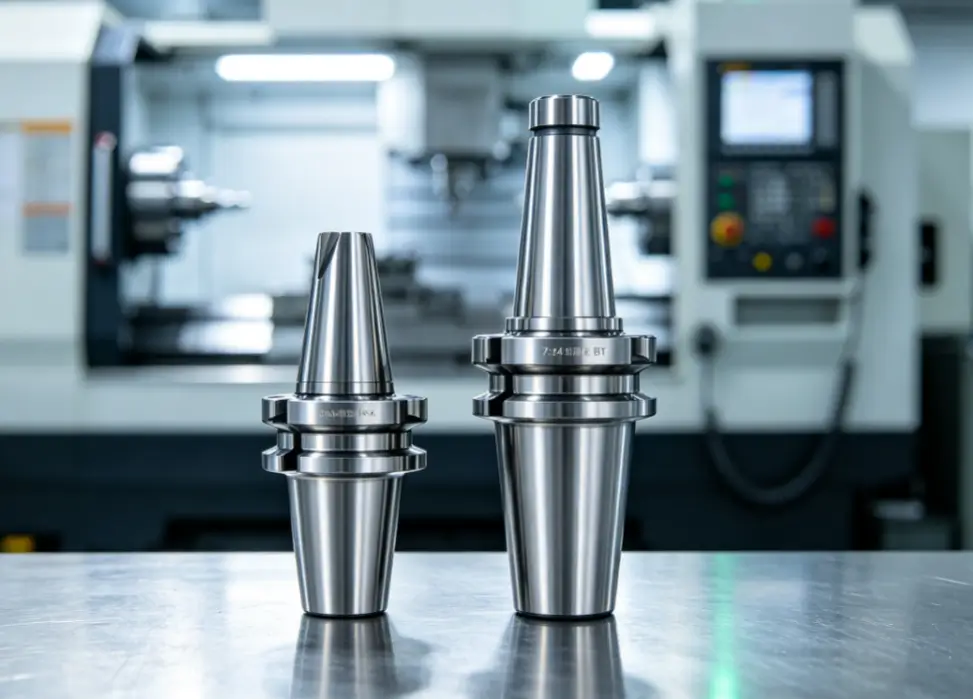
Ⅱ Features and Advantages of the Short Knife Handle System
The short tool holder is the first choice in high-speed machining, its design is more in line with the requirements of modern machining center for high speed and high precision. The representative of short tool holder is HSK (hollow short cone) tool holder, it adopts 1:10 short cone structure, and realizes double positioning by the way of positioning through the conical surface and the end face at the same time.
The HSK tool holder is hollow with a short cone length, which is beneficial to the lightness and high speed of tool changing. The hollow cone and end face positioning can effectively compensate the difference of radial deformation between the spindle hole and the tool holder during high speed machining, and completely eliminate the axial positioning error, which makes high speed and high precision machining possible.
Compared with the traditional 7:24 taper tool holder, the HSK short tool holder demonstrates significant advantages under high-speed rotation (especially when the rotational speed exceeds 8000 rpm). Under centrifugal force, the traditional BT tool holder shows a noticeable difference in expansion between the outer part of the tool holder and the spindle hole, causing the tool holder to move backward and altering its axial position, which affects machining accuracy.
The HSK short handle system compensates for this deformation difference through end-face contact, maintaining extremely high connection rigidity and stability.
Another important advantage of the short tool holder is its light weight, which facilitates rapid tool changes and reduces idle time. When applied to machining centers, the lightweight design of the short tool holder significantly increases tool change speed, thereby enhancing overall production efficiency.
For five-axis machining centers, short tool holders offer distinct advantages due to their compact design. When processing complex curved surfaces or performing multi-axis operations, short tool holders provide superior interference avoidance capabilities, enabling the machine tool to maintain optimal cutting performance even at complex angles.
Ⅲ Application scenarios and limitations of long blade handles
The long tool holder typically refers to the conventional 7:24 taper tool holder, such as models BT, SK, and BBT. This type of tool holder has been widely used in various machining centers for over half a century. The long tool holder features a solid long taper structure with a 7:24 taper ratio. The taper of the tool holder is tightly engaged with the spindle's internal conical surface under the axial tension of the pull rod.
The primary advantages of long tool holders include their versatility, cost-effectiveness, and ease of use. The standard 7:24 taper connection enables quick tool change, with only one dimension requiring high-precision machining. This design ensures both cost efficiency and reliability, making long tool holders a viable option for operations at standard speeds (below 8000 rpm).
However, with the development of high-speed machining technology, the limitations of long tool holders become increasingly apparent.
- Insufficient connection stiffness: the long tool holder can not realize the simultaneous positioning with the spindle end face and the inner conical surface, which leads to the low connection stiffness, especially under the condition of high speed cutting.
- High-speed performance limitation: Under high-speed rotation (especially over 8000rpm), the centrifugal force reduces the contact area between the tool holder and the spindle, leading to decreased radial stiffness and positioning accuracy.
- The problem of tool changing efficiency: the solid long taper handle structure is heavy, and the tool changing speed is slow when it is used on machining center, which leads to long non-processing time.
- The difficulty of disassembly: after high speed cutting, the radial elastic recovery of the tool holder and the spindle is different, which makes the tool holder easy to be stuck in the spindle and difficult to disassemble.
Long tool holders are primarily designed for heavy cutting operations at low speeds. When high torque transmission is required rather than high rotational speeds, their solid construction provides sufficient rigidity. In mold manufacturing and heavy machinery processing, long tool holders remain the preferred choice for heavy cutting due to their exceptional bending resistance.
Ⅳ Key technical parameters and selection criteria of the blade handle
Conicity standard
The tool holders for machining centers are available in two standard taper ratios: the conventional 7:24 universal taper (BT/DIN/JT) and the 1:10 HSK hollow short taper.
- BT tool holder: Suitable for conventional machining at speeds ≤10,000 r/min, with relatively low cost.
- HSK tool holder: engineered for high-speed applications (≥15,000 r/min), featuring a dual-contact design with 1μm axial repeat positioning accuracy.
The spindle type and the maximum working speed of the machining center should be considered first.
Clamping method
Different tool clamping methods directly affect the machining effect:
- Spring jacket handle (ER type): suitable for φ1-20mm drill bit and milling cutter, clamping accuracy 0.01-0.03mm, strong versatility.
- Hydraulic tool holder: delivers uniform clamping force (up to 3,000N) with runout <5μm, ideal for precision milling operations and featuring superior vibration damping.
- Thermally expanded tool holder: Achieves μm-level positioning through thermal expansion, particularly suitable for high-speed cutting (over 30,000 rpm) of φ0.5-32 mm. It offers high clamping accuracy but relatively poor vibration damping performance.
- The side-supported tool holder is the first choice for heavy cutting, which can bear the torque of more than 500N·m, but the precision is low, mainly suitable for rough machining.
Dynamic performance parameters
Pay special attention to the following parameters during high-speed machining:
- Dynamic balance ratings: G2.5 is suitable for speeds below 15,000 r/min, while G1.0 is essential for high-speed cutting operations.
- Radial runout: the precision machining requires that the radial runout is less than 0.003mm.
- Weight control: The total length of the handle should be less than 120mm, and the weight of HSK63 handle should be ≤0.8kg to reduce the influence of centrifugal force.
Materials and Techniques
High-grade tool holders are typically fabricated from 42CrMo alloy steel through vacuum heat treatment (HRC52-55), achieving a fatigue life three times longer than standard 45 steel. Surface treatment is equally critical; for instance, HSK-E and HSK-F heat shrink tool holders incorporate anti-rust coatings to enhance durability.
Ⅴ The Practical Influence of Short Handle and Long Handle on Machining Quality
Processing accuracy
The short tool holder achieves superior repeatability through simultaneous positioning of its conical and end face surfaces. In five-axis machining, the HSK short tool holder maintains radial runout control within ≤0.005mm, whereas conventional BT long tool holders typically reach only around 0.01mm. This precision disparity proves particularly critical in precision mold and aerospace component manufacturing, directly determining part tolerances and mating accuracy.
The end face positioning design of the short knife handle effectively eliminates the axial positioning error and ensures the consistency of depth control. In the cavity machining and contour milling, this stability means that there is no need for frequent measurement and adjustment, which greatly improves the machining efficiency.
Surface quality
The vibration of the tool holder directly affects the surface quality of the workpiece. The short tool holder, due to its light weight and high rigidity, generates less centrifugal force during high-speed rotation, effectively reducing vibration and thus achieving better surface finish. Experiments show that under the same cutting parameters, the surface roughness of workpieces processed with the HSK short tool holder can be improved by more than 40% compared to the BT tool holder.
Long tool handle is easy to cause vibration in high speed machining, especially when the overhang is long. The vibration not only affects the surface quality, but also causes the tool wear prematurely. For the mold machining which requires high gloss surface, short tool handle is often the best choice.
Blade life
A suitable tool holder can significantly extend the tool's service life. Short tool holders provide higher rigidity and better dynamic balance, reducing vibration during cutting and ensuring more uniform force distribution. Practical applications show that using an appropriate tool holder system can increase the tool's lifespan by 2-3 times.
Modern tool holder systems, such as hydraulic and thermal expansion holders, provide more uniform clamping force to avoid stress concentration, thereby reducing the probability of micro-chipping and damage. This is especially critical for small-diameter tools where uniform clamping force is essential.
Productivity
The lightweight design of the short tool holder allows for faster tool changing speed and reduces the non-processing time. On the machining center, the tool holder mass directly affects the acceleration and deceleration of the tool changing mechanism. The lightweight short tool holder can shorten the tool changing time by 20%-30%.
The short tool holder enables higher spindle speeds, fully utilizing the high-speed capabilities of modern machining centers. HSK tool holders can reach up to 50,000rpm or higher, whereas traditional BT tool holders are typically limited to 10,000-15,000 rpm.
Ⅵ How to choose the right tool holder according to processing requirements
Based on the selection of processing materials
The optimal handle selection varies with different materials:
- For general cutting, long tool handles are economical and practical, but for high-speed finishing, short tool handles are recommended.
- For hard-to-machine materials (e.g., titanium alloys or superalloys), use short-handled knives with special coatings to reduce chipping risk and improve heat dissipation.
- Composite and aluminum alloy: High speed short tool holder is the first choice, because it can suppress vibration to the maximum and obtain clean cutting surface.
Selection based on processing type
- The rough machining and heavy cutting: the rigidity of long tool handle is more suitable for heavy cutting.
- The semi-precision machining can use high performance hydraulic tool holder or thermal expansion tool holder to balance the precision and efficiency.
- For precision machining, the short-hand tool system (e.g. HSK with thermal expansion tool holder) is the optimal choice.
- Deep cavity machining: when the tool holder is extended, the modular tool holder system with better rigidity should be selected.
Selection based on machine tool spindle
- Conventional spindle (≤10,000 rpm): long tool holder is economical and practical.
- For high-speed spindle operations (10,000-30,000 rpm), the HSK short-handled tool is the optimal choice.
- For ultra-high-speed spindles (≥30,000 rpm), a specially designed thermal expansion short tool holder must be used.
The spindle taper hole type is the primary consideration, and it is essential to ensure a perfect fit between the tool holder and the spindle.
Cost-benefit-based selection
For mass production, the investment in high-performance short tool holder system can bring significant returns. Studies show that although the initial investment of high-quality tool holder is higher, it can usually be recovered in a relatively short time by improving production efficiency, extending tool life and reducing downtime.
For multi-variety and small-batch production, the modular tool holder system can be considered, which can realize flexible production and improve the utilization rate of tool holder by combining different chuck and extension rod.
With the continuous emergence of new materials and technologies, tool holder technology is also advancing. Current trends include smarter tool holder systems with integrated sensors for real-time monitoring of cutting forces and temperatures, lighter composite materials in manufacturing, and more efficient cooling channel designs to enhance deep cavity machining efficiency.
For any machining enterprise, investing in a suitable tool holder system is a worthwhile investment. Upgrading a few key tool holders can boost the performance of the entire machining center by over 30%, which is not only a technical upgrade but also a strategic investment.

 Email
Email sales1: +86 15312799623