



Siemens CNC Alternatives for Medical Parts Machining: FANUC vs. Mitsubishi
There is no universally best Siemens CNC alternative for medical parts machining. Consider SINUMERIK ONE when digital twins, complex five-axis motion, and automation integration are priorities. FANUC 31i-B5 Plus is a strong candidate for standardized five-axis production, while Mitsubishi M850V is worth evaluating when the machine OEM integrates the controller, servos, and spindle as one system. Make the final decision through identical-part cutting trials, ISO-based machine acceptance, and five-year total cost of ownership.
What should a medical parts manufacturer assess before replacing Siemens CNC?
The main risk is not whether the new controller can execute G-code. It is whether the established manufacturing process can be transferred without losing dimensional capability, surface quality, traceability, or uptime.
Program conversion can change part quality. Changes in the postprocessor, tool compensation, acceleration profiles, corner smoothing, and five-axis kinematics can affect contour error, blend marks, burr locations, and surface texture even when the same CAD model is used.
Controller resolution is not finished-part accuracy. Terms such as “nano interpolation” describe internal trajectory calculations. Actual part error also depends on machine geometry, feedback devices, spindle thermal growth, fixture deformation, tool wear, coolant temperature, and measurement uncertainty.
Purchase price is not total cost of ownership. Postprocessor development, PLC and safety engineering, training, spare parts, data interfaces, validation, and downtime should all be included:
TCO5 years=Purchase+Engineering+Training+Validation+Maintenance+Downtime−Measured productivity gains
For example, if a production line contributes RMB 8,000 per day and a control migration stops it for 15 days, the downtime opportunity cost alone is RMB 120,000. Scrap, rework, and delayed deliveries would be additional costs.
How do SINUMERIK ONE, FANUC 31i-B5 Plus, and Mitsubishi M850V compare?
To keep the comparison reasonably consistent, the following table focuses on high-performance control configurations for five-axis machining centers:
- Siemens SINUMERIK ONE with NCU 1750 or NCU 1760;
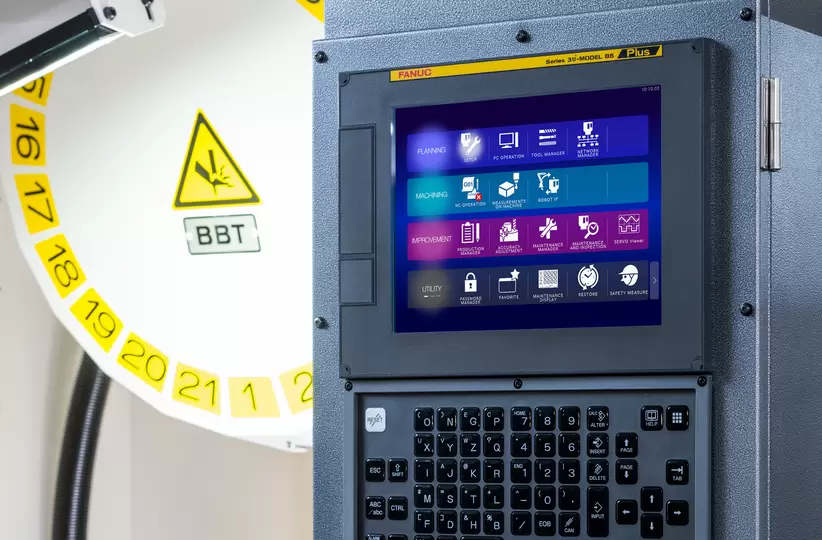
- FANUC 31i-B5 Plus;
- Mitsubishi M850V.
These platforms are relevant to complex orthopedic components, surgical instruments, freeform surfaces, and multi-face machining in one setup. Standard three-axis medical parts may not require this control class.
| Selection factor | SINUMERIK ONE NCU 1750/1760 | FANUC 31i-B5 Plus | Mitsubishi M850V |
|---|---|---|---|
| Platform focus | Multi-technology machining, digital twins, and complex automation | High-performance five-axis and multipath control | High-speed, high-accuracy, multiaxis integration |
| Maximum control scale | Up to 31 NC axes/spindles | Up to 34 controlled axes; 16 per path | 16 axes standard; up to 32 as an option |
| Per-channel or per-path capability | With CNC software 6.24 or later, up to 31 axes/spindles per channel | Up to 5 simultaneously controlled axes per path | Up to 8 simultaneous contouring axes on M850V |
| Maximum channels or paths | Up to 10 machining channels | Up to 6 controlled paths | Up to 8 part systems, depending on options |
| Program processing | Typical block times of about 0.3 ms for NCU 1750 and 0.2 ms for NCU 1760, with compressor required | AI Contour Control, Nano Smoothing, and Fine Surface Technology | High-Speed High-Accuracy Control III up to 540 kBPM |
| Five-axis functions | Multiaxis interpolation, tool-center-point control, and advanced surface functions, depending on licenses | TCP control, 3D tool compensation, and tilted working plane | TCP, inclined-surface machining, 3D tool compensation, and SSS control, depending on options |
| Virtual commissioning | Create MyVirtual Machine and Run MyVirtual Machine | CNC Guide and OEM-specific simulation | NC Trainer and OEM engineering tools |
| Data connectivity | OPC UA, PROFINET, and the TIA Portal ecosystem | FOCAS, Ethernet, and MT-LINKi ecosystem | CNC API, MTConnect, OPC UA, and MQTT solutions |
| Stronger fit | Complex automation, multiple technologies, or NC-kernel-based offline verification | Standardized processes and replication across similar machines | OEMs with established Mitsubishi control, servo, and spindle integration |
| Primary purchasing risk | NCU, software, and engineering licenses can be complex | Advanced five-axis and data functions must be confirmed in the quotation | Exact controller type, part systems, and high-speed options must be specified |
The 31-axis SINUMERIK ONE configuration is documented in Siemens’ 2026 NC 63 catalog. FANUC currently lists 34/16 controlled axes, five simultaneously controlled axes per path, and six paths for the 31i-B5 Plus. Mitsubishi’s 32-axis capacity and 540 kBPM rating apply only to specified M850V configurations and operating conditions. FANUC 31i-B5 Plus specifications, Mitsubishi M800V/M80V function manual
Do standard three-axis and four-axis medical parts need a premium five-axis CNC?
Not necessarily.
For valve bodies, connectors, instrument housings, and clamping components with moderate toolpaths and infrequent changeovers, SINUMERIK 828D, FANUC 0i-MF Plus, or Mitsubishi M80V may provide a better balance between capability and cost.
The latest M800V/M80V manual lists the following machining-center capacities:
| Mitsubishi model | Maximum total axes, including NC, spindle, and PLC axes | Maximum NC axes | Simultaneous contouring axes |
|---|---|---|---|
| M80VW | 12 | 9 | 4 |
| M80V Type A | 16 | 9 | 4 |
| M80V Type B | 9 | 5 | 3 |
“Up to 16 axes” does not mean 16-axis simultaneous interpolation. The purchase specification should state the total axis count, NC axis count, simultaneous contouring axes, spindle count, and number of part systems separately.
Does 540 kBPM on the Mitsubishi M850V guarantee a better surface finish?
No.
The 540 kBPM figure describes micro-segment processing capacity in High-Speed High-Accuracy Control III. Mitsubishi specifies several conditions for this rating:
- No more than three axes commanded simultaneously in G01;
- Blocks contain only axis names and movement amounts;
- No macro or variable commands;
- Tool-radius compensation is off with G40.
Actual performance may differ during simultaneous five-axis movement, tool-center-point control, or complex macro execution. Evaluate kBPM together with feed-rate retention, contour error, surface roughness, and actual cycle time.
Does a 0.2 ms SINUMERIK ONE block time mean faster machining?
Not by itself.
Siemens lists approximately 0.2 ms for NCU 1760 and 0.3 ms for NCU 1750 as typical block-processing times, with compressor required. Siemens also notes that combinations of CNC functions and options can reach the system’s performance limit, making OEM configuration validation necessary.
Because manufacturers do not necessarily use identical benchmark methods, comparing “0.2 ms versus 540 kBPM” does not establish a valid speed ranking. Run the same NC program on each candidate machine and record:
- Actual cutting and total cycle time;
- Difference between programmed and achieved feed;
- Freeform contour error;
- Corner overcut and undercut;
- Ra and Rz surface roughness;
- Servo loads and alarms.
How should a medical-parts CNC machine be accepted?
The following are acceptance methods, not universal medical-industry thresholds. Numerical limits should be derived from the part drawing, material, tooling, and process validation.
| Acceptance item | What the contract should define | Verification method |
|---|---|---|
| Working envelope | Maximum part, fixture, tool, and rotary-swing clearances in mm | 3D interference review and physical setup |
| Spindle capability | Maximum rpm, continuous kW, peak kW, and torque curve | Continuous cutting in the target material |
| Coolant performance | Tool-tip pressure in MPa and corresponding flow in L/min or m³/h | Simultaneous pressure and flow measurement |
| Linear positioning | Permitted positioning and repeatability errors in μm | ISO 230-2 laser interferometer test |
| Circular performance | Circle diameter, feed rate, test plane, and allowed error in μm | ISO 230-4 circular test |
| Five-axis cutting | Defined test piece, contour tolerance, and inspection method | ISO 10791-7 test piece and CMM inspection |
| Surface finish | Ra, Rz, and lay direction for each functional surface | Calibrated surface-roughness instrument |
| Process capability | Buyer-defined Cpk target and sample size based on risk | Statistical analysis of consecutive production lots |
| Environmental conditions | Room temperature, coolant temperature, and air pressure in MPa | Recorded during FAT and SAT |
For example, if a titanium deep-hole trial establishes a requirement of 7 MPa at 20 L/min, both values should appear in the contract. A flow of 20 L/min equals 1.2 m³/h, but this operating point is not a universal requirement for PEEK or shallow-hole machining.
ISO 230-2:2014 covers positioning accuracy and repeatability of numerically controlled axes. ISO 230-4:2022 addresses circular and contouring performance. ISO 10791-7:2020 defines finished test pieces for evaluating three- to five-axis machining centers.
Are Cpk 1.33 and 1.67 regulatory requirements for medical devices?
No.
Cpk≥1.33 and Cpk≥1.67 are common customer or internal process-capability targets, but FDA QMSR and ISO 13485 do not impose either value on every medical component.
The manufacturer should determine the required Cpk and sample size from the critical quality characteristic, product risk, measurement-system capability, and applicable quality agreement. An industry convention should not be presented as a regulatory requirement.
How should a Siemens CNC alternative be validated for accuracy and traceability?
Which controller models and software options should be verified?
The machine OEM should submit a complete bill of materials and software license list covering:
- Full CNC, NCU, or CPU model;
- Control software and HMI versions;
- NC axes, spindle axes, PLC axes, and machining channels;
- Five-axis kinematics and TCP licenses;
- Safety PLC, door interlocks, and safe-motion functions;
- Probe, linear-scale, and tool-monitoring interfaces;
- OPC UA, MTConnect, or proprietary API licenses;
- Backup procedures for parameters, PLC logic, and NC programs.
A quotation that states only “Siemens control” or “FANUC five-axis control” is not sufficiently specific for technical purchasing.
Which machine-accuracy reports should the OEM provide?
Factory and site acceptance testing should include:
- Laser-interferometer positioning report;
- Circular or ballbar test report;
- Spindle thermal-drift record;
- Five-axis center-of-rotation calibration;
- Continuous-load test;
- Safety-function and power-recovery test.
A citable record should read:
With the shop at 20±1°C and a 500 mm test travel, the X-axis measured 4.2 μm bidirectional positioning error and 2.1 μm repeatability.
Terms such as “high precision,” “high stability,” and “medical grade” cannot replace a report containing test conditions, instruments, and numerical results.
What should be recorded during target-material cutting trials?
Trials should use the actual material or a technically justified equivalent, such as titanium alloy, 316L stainless steel, cobalt-chromium alloy, or PEEK. Record:
- Cutting time and total cycle time;
- Critical dimensions and process capability;
- Ra, Rz, and blend marks;
- Burr location and deburring labor;
- Tool life and tooling cost per part;
- First-piece and consecutive-lot yield;
- Coolant condition and ambient temperature.
Axis count, interpolation resolution, and processing speed cannot substitute for these process results.
Which production records should be traceable to each medical-parts lot?
The manufacturer should determine the required records through product and process risk analysis. Relevant data may include:
- NC program name, revision, and checksum;
- Tool number, tool life, and offset values;
- Machine and operator identification;
- Alarm and downtime records;
- In-process and final inspection results;
- Parameter changes, timestamps, and authorization;
- Nonconformance and rework records.
FDA’s Quality Management System Regulation became effective on February 2, 2026, and incorporates ISO 13485:2016 by reference. QMSR requires controlled quality records and manufacturing processes, but it does not mandate OPC UA or any specific CNC traceability platform. Manufacturers should select a collection method appropriate to their risks and quality system. FDA QMSR information
Can FANUC’s reported 45% medical-production increase be replicated?
FANUC’s published Smith+Nephew case concerns a machining cell for titanium hip stems. The project used an LR-10iA/10 robot, dynamic position scanning, and FANUC DCS safety functions for machine loading and unloading.
The published results include:
- A 45% increase in hip-implant machining throughput;
- Four hours of autonomous production per day;
- A 10 kg robot payload;
- A 1,101 mm robot reach.
View the FANUC medical manufacturing case
If the original daily output is BB and the factory operates 250 days per year, the theoretical annual capacity increase is:
Additional annual capacity=B×45%×250=112.5B
At a baseline of 100 parts per day, this equals a theoretical additional capacity of 11,250 parts per year. This is an annualized calculation based on the published percentage, not a reported annual result from the case study.
The 45% improvement came from the complete automation cell, including the robot, scanning method, safety system, fixture, machine tool, and production organization. It should not be attributed solely to the FANUC CNC.
The published case also does not provide 12 months of monthly source data. A credible 12-month review should track:
- Conforming output and first-pass yield;
- Cutting, loading, and changeover time;
- Tool life and tooling cost per part;
- Unplanned downtime;
- Cpk for critical dimensions;
- Scrap and rework causes;
- Lot-traceability completeness.
Frequently asked questions about Siemens CNC alternatives
Q: Can micron-level machining accuracy be determined from the controller brand?
A: No. The controller is only one part of the accuracy chain. Evaluate the configured machine and a finished test piece using ISO 230-2, ISO 230-4, and ISO 10791-7 methods.
Q: Can the existing NC programs be released directly to production?
A: No. Revalidate the postprocessor, coordinate systems, tool compensation, canned cycles, five-axis kinematics, corner behavior, safety PLC, program revision control, and representative-part process capability.
Q: Is titanium machining inherently better on one controller brand?
A: No. Compare low-speed spindle torque, tool-tip coolant pressure and flow, path smoothing, thermal compensation, tool-load monitoring, and local application support. Decide through cutting trials in the target titanium grade.
Q: Is higher spindle speed the only important requirement?
A: No. Also evaluate cutting temperature, chip evacuation, clamping deformation, tool sharpness, coolant compatibility, burr formation, contamination risk, and dimensional recovery after machining.
Q: Is the lowest-priced control system automatically the least expensive choice?
A: No. Add hardware, software options, postprocessor development, PLC engineering, training, spares, maintenance, data integration, revalidation, and downtime. Then subtract only cycle-time, yield, and changeover gains confirmed by testing.
How can buyers obtain comparable CNC machine configurations?
If you have not decided between Siemens, FANUC, and Mitsubishi, you can provide Minnuo CNC with the part drawings, material, critical tolerances, annual volume, and automation requirements. Its engineers can use these inputs to prepare alternative machine configurations covering the control, spindle, tool magazine, probing, and loading system.
Minnuo’s website lists FANUC 0i/30i/31i, Siemens 808D/828D/840D, and Mitsubishi M70/M80 among its available control families. Review Minnuo machining-center options
 Email
 sales1: +86 15312799623