



Slant Bed CNC Lathe Used in Aerospace Industry
The aerospace industry represents the highest standard of precision manufacturing in the modern industrial system. With extremely strict requirements for part accuracy, material stability, surface finish, and batch consistency, aerospace component manufacturing tolerances often reach micron-level precision, leaving almost no room for processing errors. Even tiny vibration, thermal deformation, or tool runout can lead to part failure and potential flight safety hazards. For this reason, ordinary flat bed CNC lathes and light-duty turning equipment cannot meet aerospace production standards. In high-end aerospace precision machining, the slant bed CNC lathe has gradually become the preferred and most widely used processing equipment. Thanks to its high rigidity structure, excellent vibration resistance, stable thermal balance, superior chip removal performance, and high repeat positioning accuracy, the slant bed CNC lathe has become an indispensable core machine for manufacturing aircraft structural parts, engine components, aviation hydraulic parts, and aerospace precision shaft parts.
The fundamental reason why slant bed CNC lathes are widely adopted in the aerospace industry lies in their unique mechanical structural advantages compared with traditional flat bed lathes. Aerospace parts are mostly made of difficult-to-cut materials such as titanium alloy, stainless steel, high-temperature alloy, and high-strength aluminum alloy. These materials feature high hardness, high toughness, and strong cutting resistance, which require machine tools to provide ultra-high rigidity and structural stability during processing. Different from the horizontal open structure of flat bed lathes that is prone to vibration and deformation, the 45-degree integral inclined bed design of aerospace-grade slant bed CNC lathes forms a stable triangular mechanical support structure. The whole machine adopts one-piece high-grade cast iron casting and multiple stress relief aging treatments, which completely eliminates internal structural stress and ensures long-term stable operation without deformation. This structural superiority greatly suppresses cutting vibration and micro-jitter during heavy-load and fine finishing, enabling the equipment to maintain ultra-high stability even when processing super-hard aerospace materials.
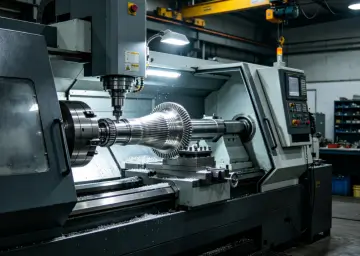
Precision consistency is the core threshold of aerospace manufacturing, and slant bed CNC lathes excel in long-term high-precision repeated processing. Aerospace batch production requires thousands of parts to maintain unified dimensional tolerance and surface roughness, and any accuracy attenuation will lead to batch scrap. Professional aerospace slant bed CNC lathes are equipped with high-precision roller linear guideways, large-diameter precision ball screws, and high-rigidity spindle units. The spindle adopts precision angular contact bearing groups, which effectively control spindle runout within 0.001mm. The closed-loop servo control system ensures positioning accuracy within ±0.003mm and repeat positioning accuracy up to ±0.001mm. Whether it is roughing material removal or ultra-fine finishing, the machine tool can always maintain stable precision, fully meeting the strict tolerance standards of aerospace parts such as tight-fitting shaft components, sealing structural parts, and engine precision accessories.
Efficient and clean chip evacuation is another key factor that makes slant bed CNC lathes irreplaceable in aerospace manufacturing. Aerospace parts have extremely high requirements for surface finish and cleanliness, and residual iron scraps, tool scratches, or cutting heat marks will directly cause parts to be unqualified. Traditional flat bed lathes easily accumulate chips on the guide rails and workbench during processing, resulting in secondary scratching of the workpiece and poor surface finish. In contrast, the inclined bed structure of the slant bed CNC lathe uses gravity to automatically slide down high-temperature chips and coolant, effectively avoiding chip accumulation and secondary cutting. Equipped with a professional cooling and filtering system, it can take away cutting heat in real time, reduce thermal deformation of the workpiece and spindle, and ensure that the surface finish of aerospace parts can reach Ra 0.8μm or higher, meeting the ultra-clean and high-precision surface standards required for aviation assembly.
Aerospace component processing involves complex composite processes including turning, milling, drilling, tapping, and grooving, which requires machine tools with powerful expandable processing capabilities. Modern aerospace dedicated slant bed CNC lathes support high-precision C-axis positioning and optional power turret functions, realizing one-time clamping and composite processing of complex parts. This greatly reduces repeated positioning errors caused by multiple clamping, improves the overall processing precision of complex aerospace structural parts, and shortens the production cycle. At the same time, the equipment is compatible with mainstream high-end CNC systems such as FANUC and Siemens, which feature strong anti-interference performance, stable program operation, and intelligent tool wear monitoring functions. In the continuous processing of high-value aerospace parts, the system can automatically identify abnormal tool wear and processing status, effectively avoiding defective products caused by tool failure and improving the yield rate of high-precision parts.
The main application scenarios of slant bed CNC lathes in the aerospace industry cover core fields such as aviation aircraft, aerospace engines, hydraulic systems, and precision transmission components. In aircraft manufacturing, it is mainly used for processing aviation precision shafts, landing gear small accessory parts, aircraft hub components, and structural fasteners. These parts require high roundness, high coaxiality, and excellent surface consistency, which can only be stably completed by high-rigidity slant bed lathes. In aero-engine manufacturing, the equipment is responsible for processing engine thin-wall parts, turbine shaft accessories, and high-temperature alloy connectors. Due to the slant bed’s excellent anti-vibration and anti-deformation capabilities, it can effectively solve the processing difficulties of thin-wall parts that are easy to deform, ensuring the dimensional stability of engine core components.
In aerospace hydraulic and fuel system parts manufacturing, slant bed CNC lathes ensure the high sealing and high matching precision of valve bodies, valve cores, and hydraulic connector parts. These precision fluid control components are related to flight safety, and their tolerance consistency and surface flatness must reach aerospace-grade standards. In addition, with the rapid development of aerospace lightweight technology, more and more thin-wall aluminum alloy and composite material parts are widely used. The stable feed motion and uniform cutting force of slant bed CNC lathes can effectively suppress thin-wall part deformation, solving the long-standing processing pain points in the aerospace industry.
Compared with ordinary industrial lathes, aerospace-grade slant bed CNC lathes also have significant advantages in long-term reliability and anti-fatigue performance. Aerospace production features small batch, multi-variety, and high-value processing characteristics, requiring machine tools to maintain stable precision for a long time without frequent calibration and maintenance. The overall rigid structure, wear-resistant transmission components, and optimized thermal balance design of the slant bed lathe greatly reduce precision loss caused by long-term operation. It can maintain consistent processing accuracy for years of intermittent and continuous production, helping aerospace manufacturers stabilize product quality, reduce scrap rates, and lower comprehensive production costs.
In conclusion, the slant bed CNC lathe has become the mainstream precision processing equipment in the aerospace industry by virtue of its high rigidity, ultra-high precision, excellent stability, clean processing performance, and powerful composite processing capabilities. It perfectly matches the ultra-high standards of aerospace manufacturing in terms of precision, stability, surface quality, and batch consistency. As aerospace technology continues to iterate and the demand for high-precision lightweight components increases, slant bed CNC lathes will play an increasingly important role in aircraft manufacturing, engine production, and aerospace precision component processing, becoming an essential strategic equipment supporting the high-quality development of the global aerospace manufacturing industry.
 Email
Email sales1: +86 15312799623