



Swiss Type Lathe vs Traditional Lathe: Key Differences
When it comes to precision turning, choosing the right lathe can make or break your production efficiency, part quality, and bottom line. Two of the most common options in manufacturing are the Swiss Type Lathe (also known as a sliding head lathe) and the Traditional Lathe (fixed head lathe). While both machines are used for turning operations—shaping metal or plastic parts by rotating the workpiece against a cutting tool—they differ dramatically in design, capabilities, and ideal applications.
Understanding the key differences between a Swiss Type Lathe and a Traditional Lathe is critical for manufacturers, engineers, and buyers looking to optimize their production processes. This guide breaks down the core distinctions in design, precision, speed, part size, applications, and cost—helping you decide which machine is best for your specific needs. Whether you’re producing small, high-tolerance components or larger, more robust parts, this comparison will clarify why one lathe may outperform the other.
Design & Core Mechanism: Sliding Head vs Fixed Head
The most fundamental difference between a Swiss Type Lathe and a Traditional Lathe lies in their design—specifically, how they hold and move the workpiece during machining. This design difference drives nearly all other variations in performance and capability.
Swiss Type Lathe: Sliding Head Design
A Swiss Type Lathe (sliding head lathe) gets its name from its origin in Switzerland, where it was developed to produce high-precision watch parts. Its defining feature is a sliding headstock that moves parallel to the cutting tool (instead of the tool moving alone). The workpiece is held in a collet at the headstock, and as the headstock slides, the cutting tool remains stationary relative to the machine’s frame.
Key design elements of a Swiss Type Lathe include:
- A guide bushing that supports the workpiece near the cutting tool, minimizing deflection (critical for long, slender parts).
- Multiple tool stations (often 10–20) that allow for simultaneous turning, milling, drilling, and tapping in a single setup.
- A compact footprint, despite its advanced capabilities, making it ideal for shops with limited space.
Traditional Lathe: Fixed Head Design
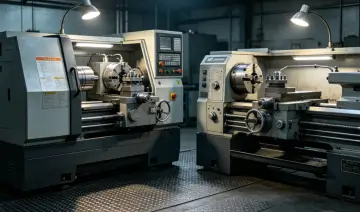
A Traditional Lathe (fixed head lathe) features a stationary headstock that holds the workpiece in a chuck or collet. The cutting tool is mounted on a carriage that moves along the length of the workpiece to shape it. This design is simpler, more straightforward, and has been used in manufacturing for decades.
Key design elements of a Traditional Lathe include:
- A fixed headstock that does not move during machining—all movement comes from the tool carriage.
- Fewer tool stations (typically 2–4), requiring multiple setups for complex parts that need turning, milling, or drilling.
- A larger footprint, especially for heavy-duty models designed for large workpieces.
Precision & Tolerance: Swiss Type Lathe Takes the Lead
Precision is where the Swiss Type Lathe and Traditional Lathe differ most significantly—making the Swiss Type Lathe the go-to choice for high-tolerance applications.
Swiss Type Lathe: Ultra-High Precision
Swiss Type Lathes are engineered for tight tolerances, often achieving ±0.001mm (1 micron) or better. This precision is made possible by the guide bushing, which supports the workpiece close to the cutting tool—eliminating deflection that occurs with long, slender parts. The sliding headstock design also ensures consistent tool-to-workpiece alignment, reducing human error and improving repeatability.
Ideal for parts that require strict dimensional accuracy, such as medical implants, electronic connectors, and watch components.
Traditional Lathe: Standard Precision
Traditional Lathes typically achieve tolerances of ±0.01mm to ±0.05mm—sufficient for most general manufacturing applications but not for high-precision parts. Without a guide bushing, long or slender workpieces are prone to deflection, leading to variations in dimensions. While some high-end Traditional Lathes can achieve tighter tolerances, they cannot match the consistency of a Swiss Type Lathe for small, delicate parts.
Best for parts where precision is important but not critical, such as automotive brackets, pipes, and general machine components.
Part Size & Geometry: Small vs Large, Simple vs Complex
The two lathes are optimized for very different part sizes and geometries—another key factor in choosing the right machine.
Swiss Type Lathe: Small, Slender, Complex Parts
Swiss Type Lathes excel at machining small, long, and slender parts—typically with diameters ranging from 0.1mm to 32mm (and up to 50mm for larger models). The guide bushing and sliding head design make them ideal for parts with high length-to-diameter ratios (e.g., 20:1 or higher), such as:
- Medical devices (catheter shafts, surgical pins, dental implants)
- Electronic components (connectors, pins, small gears)
- Watch parts (hands, gears, shafts)
- Aerospace micro-components
Additionally, Swiss Type Lathes can handle complex geometries in a single setup, thanks to multiple tool stations and simultaneous machining capabilities. This eliminates the need for multiple setups, reducing production time and errors.
Traditional Lathe: Large, Robust, Simple Parts
Traditional Lathes are designed for larger, more robust parts—with diameters ranging from 20mm to several hundred millimeters (or more for heavy-duty models). They are ideal for parts with larger cross-sections and simpler geometries, such as:
- Automotive parts (crankshafts, camshafts, axles)
- Pipes, tubes, and cylindrical components
- General machine parts (bushings, sleeves, large gears)
- Prototypes and small-batch production of larger parts
While Traditional Lathes can handle some complex parts, they require multiple setups, which increases production time and reduces efficiency for intricate designs.
Speed & Efficiency: High-Volume vs Flexible Production
Speed and efficiency vary between the two lathes, depending on the part type and production volume.
Swiss Type Lathe: High-Speed, High-Volume Production
Swiss Type Lathes are designed for high-volume production of small parts. Their multiple tool stations allow for simultaneous machining (e.g., turning on one station, milling on another), reducing cycle times significantly. The sliding head design also minimizes tool travel, further speeding up production.
For example, a Swiss Type Lathe can produce 100–500 small parts per hour, compared to 20–50 parts per hour on a Traditional Lathe for the same part. This makes them ideal for mass production of small, high-precision components.
Traditional Lathe: Flexible, Low-to-Medium Volume
Traditional Lathes are more flexible for low-to-medium volume production and prototype work. They are easy to set up and adjust, making them ideal for small batches or custom parts. However, their single-tool or limited-tool setup means longer cycle times for complex parts, making them less efficient for high-volume production.
Traditional Lathes also excel at machining large parts that would be impossible to handle on a Swiss Type Lathe, where flexibility and adaptability are more important than speed.
Cost & Investment: Swiss Type Lathe vs Traditional Lathe
Cost is a critical consideration for any manufacturing operation, and the two lathes differ significantly in upfront investment and ongoing costs.
Swiss Type Lathe: Higher Upfront Cost, Lower Long-Term Costs
Swiss Type Lathes are more expensive upfront—typically ranging from $50,000 to $500,000 (or more for high-end models). This is due to their advanced design, multiple tool stations, and precision components. However, their high efficiency, reduced setup time, and lower scrap rates (thanks to tight tolerances) lead to lower long-term costs for high-volume production.
They also require less labor, as they can run unattended for long periods (ideal for lights-out manufacturing), further reducing operational costs.
Traditional Lathe: Lower Upfront Cost, Higher Long-Term Costs
Traditional Lathes are more affordable upfront—ranging from $10,000 to $100,000 for most models. This makes them accessible for small shops or businesses with limited budgets. However, their lower efficiency, higher scrap rates, and need for multiple setups (and more labor) lead to higher long-term costs for high-volume production.
They also require more operator intervention, increasing labor costs over time.
Key Applications: Which Lathe Is Right for You?
To summarize, the choice between a Swiss Type Lathe and a Traditional Lathe depends on your specific production needs. Here’s a quick breakdown of ideal applications for each:
Choose a Swiss Type Lathe If You Need:
- Ultra-high precision (±0.001mm or better) for small parts.
- High-volume production of small, slender, or complex parts.
- Single-setup machining for complex geometries (turning, milling, drilling in one pass).
- Parts for medical, electronic, aerospace, or watch industries.
Choose a Traditional Lathe If You Need:
- Standard precision for larger, more robust parts.
- Low-to-medium volume production or prototype work.
- Flexibility to machine a wide range of part sizes and shapes.
- A lower upfront investment for general manufacturing applications.
Conclusion: Swiss Type Lathe vs Traditional Lathe—No “One-Size-Fits-All”
There is no “better” lathe—only the right lathe for your specific needs. Swiss Type Lathes are the gold standard for high-precision, high-volume production of small, complex parts, while Traditional Lathes excel at flexible, low-to-medium volume production of larger, simpler parts.
When deciding between the two, consider your part size, precision requirements, production volume, and budget. If you’re producing small, high-tolerance parts in large quantities, a Swiss Type Lathe will deliver better efficiency, quality, and long-term value. If you need flexibility for larger parts or small batches, a Traditional Lathe is a more cost-effective choice.
By understanding these key differences, you can make an informed decision that optimizes your production process, reduces costs, and delivers high-quality parts to your customers.
 Email
Email sales1: +86 15312799623