



Two-Axis CNC Lathe vs. Y-Axis Turning Center: Capabilities, Cost, and Payback
A two-axis CNC lathe generally offers the lower-risk investment when most parts are rotational and off-center features are uncommon. A Y-axis turning center becomes more economical when recurring work requires cross-holes, keyways, flats, or off-center milling, and the resulting savings recover the price premium within the company’s target payback period. Evaluate actual process routes, part families, and order history rather than axis count alone.
What costs do first-time CNC lathe buyers most often underestimate?
The most common purchasing mistake is treating a complete part as if it requires only one turning operation.
Cross-holes, keyways, flats, off-center holes, and face-hole patterns determine whether a part requires a second setup, another machining center, additional work-in-process inventory, and repeated inspection.
- Secondary-operation costs: A two-axis lathe has a lower initial price, but subcontract milling, production queues, transportation, fixtures, and repeated inspection can create recurring expenses.
- Underutilized Y-axis capability: A Y-axis does not automatically shorten pure turning cycles. Tool interference, live-tool rigidity, programming capability, and order utilization can limit its financial benefit.
- Datum-transfer errors: Re-clamping introduces additional datum and positioning errors. When a cross-hole or milled surface must be tightly positioned relative to the turned centerline, single-setup machining can be more valuable than a small cycle-time reduction.
The financial comparison should separate four factors:
- Incremental machine investment.
- Avoidable subcontracting and handling costs.
- Productive capacity that can realistically be sold.
- Changes in scrap and rework.
Released machine hours only have financial value when the company has orders, operators, materials, and downstream capacity available to use them.
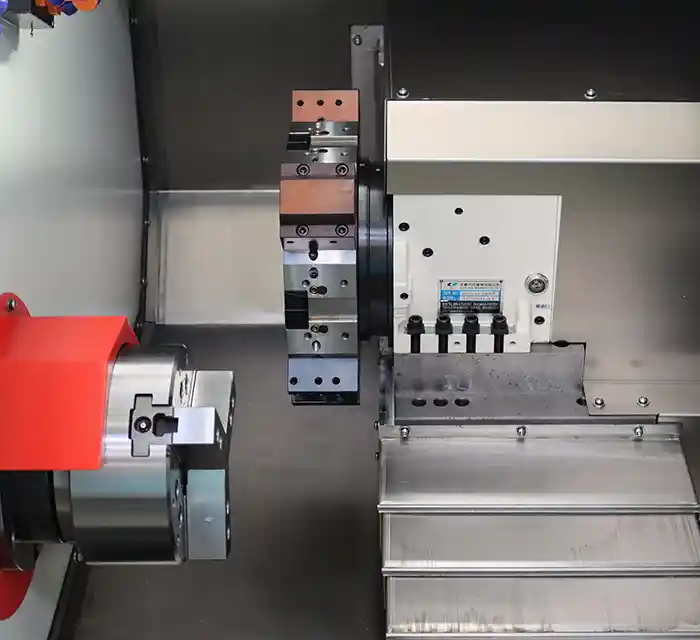
What are the key specification differences between the ST-20 and ST-20Y?
The following comparison uses the Haas ST-20 and Haas ST-20Y as a same-platform reference. A two-axis lathe combined with a separate vertical machining center, or VMC, is included because it is a common alternative.
Published specifications define machine capability but do not constitute universal acceptance guarantees. Final performance requirements must be written into the purchase contract.
| Specification | Two-axis lathe: Haas ST-20 | Two-axis lathe + separate VMC | Y-axis turning center: Haas ST-20Y |
|---|---|---|---|
| Rated spindle power | 14.9 kW | Lathe: 14.9 kW; VMC separate | 14.9 kW |
| Maximum spindle speed | 4,000 rpm | Lathe: 4,000 rpm; VMC separate | 4,000 rpm |
| Maximum bar capacity | 64 mm | 64 mm | 64 mm |
| Maximum cutting diameter/length | 330/572 mm with BOT turret; 300 mm with VDI; 298 mm with BMT65 | Same turning limits; milling depends on VMC travel | 298/572 mm |
| Y-axis travel | None | Provided by VMC | ±51 mm; 102 mm total |
| Live tooling | Not standard | Milling performed by VMC spindle | BMT65, up to 4,000 rpm |
| C-axis positioning | Optional or not applicable | Lathe indexing followed by part transfer | Interpolation and positioning; published value ±0.01° |
| Approximate shipping weight | 4,000 kg | Combined weight of both machines | 4,754 kg |
| Compressed-air requirement | 113 L/min at 0.69 MPa supply; minimum 0.55 MPa | Verify each machine separately | 113 L/min at 0.69 MPa supply; minimum 0.55 MPa |
| Recommended contractual accuracy tests | X/Z positioning accuracy and repeatability in μm | Test both machines and conduct a transfer-process study | X/Y/Z and C-axis tests plus a combined-operation test piece |
The official specifications show that both machines use a 14.9 kW spindle, reach 4,000 rpm, and accept bar stock up to 64 mm. The ST-20Y adds ±51 mm of Y-axis travel, live tooling up to 4,000 rpm, and C-axis capability. Specifications can vary by market and selected options.
Why can a Y-axis reduce secondary setups without shortening turning time?
A two-axis lathe controls the X and Z axes and is designed for outside-diameter turning, boring, facing, grooving, and threading.
A Y-axis turning center adds tool movement perpendicular to the spindle centerline. The Haas 2025 Lathe Operator’s Manual defines Y-axis movement in this direction.
Combined with a C-axis and live tooling, the Y-axis can support:
- Cross-hole drilling.
- Off-center drilling.
- Milling flats.
- Cutting keyways.
- Machining face-hole patterns.
- Profile milling.
The comparison should therefore use the total lead time required to produce a conforming finished part, not just the turning cycle time.
A separate VMC may remain more efficient for deep cavities, high-speed small-diameter milling, or parts requiring many milling tools. A Y-axis turning center is not an unconditional replacement for a VMC.
Which parts suit a two-axis lathe, and which suit a Y-axis machine?
| Part-family characteristic | Two-axis priority | Y-axis priority | Purchasing implication |
|---|---|---|---|
| Rotational parts dominated by OD, ID, and thread features | Yes | Usually no | Avoid paying for a Y-axis with low expected utilization |
| One to four cross-holes or flats per part | Requires transfer | Yes | Calculate fixture, transfer, inspection, and positioning costs |
| Off-center holes, keyways, or face-hole patterns | Limited capability | Yes | Require a trial cut using an actual production drawing |
| Deep cavities or high-speed small-tool milling | VMC may be more suitable | Live tooling may be limiting | Verify live-tool power, torque, rigidity, and thermal behavior |
| Unstable demand and low mill-turn utilization | Usually preferable | Use caution | Preserve cash flow and general-purpose capacity |
| Recurring combined-operation work | Transfer cost must be acceptable | Usually preferable | Validate utilization using 12 months of order history |
How should the incremental payback period for a Y-axis machine be calculated?
Incremental payback period in months:
Incremental Y-axis investment ÷ annual net cash benefit × 12
Annual net cash benefit:
Avoided subcontracting + avoidable direct labor + reduced scrap and rework + realizable contribution margin from additional orders − incremental tooling, programming, maintenance, and energy costs
Do not count the same labor hour twice by recording it both as direct labor savings and within a fully burdened machine-hour rate.
Additional capacity should only be assigned contribution margin when confirmed orders, operators, materials, and downstream capacity are available.
Which official data and acceptance standards support this comparison?
The Haas Y-axis technical guide describes 102 mm of total Y-axis travel for off-center milling, drilling, and tapping. Haas also presents completed-part applications on the ST-20Y product page. These examples demonstrate process capability but do not guarantee cycle time, accuracy, or return on investment for every part.
ISO 230-2:2014 defines direct and repeated measurement methods for evaluating the positioning accuracy and repeatability of numerically controlled linear and rotary axes. It can support machine acceptance, comparison, and periodic verification. The edition was reviewed and confirmed as current in 2025.
ISO 23125:2015 addresses safety requirements for CNC turning machines and turning centers, including integrated workpiece handling, clamping, and chip-removal equipment. The edition remained current in 2026 while a revised edition was under development.
ISO 14955-1:2017 establishes an energy-efficiency design methodology for machine tools, while ISO 14955-2:2018 provides methods for measuring energy supplied to machine tools and their components.
Energy comparisons must use the same part, quality outcome, production quantity, and measurement conditions. Annual electricity cost cannot be calculated reliably from spindle-rated kW alone.
What accuracy and energy data must be recorded during acceptance testing?
| Acceptance item | Instrument or method | Required record | Acceptance principle |
|---|---|---|---|
| X/Y/Z positioning and repeatability | Laser interferometer using ISO 230-2 | Bidirectional repeated measurements at multiple positions over the full travel; results in μm | Use contractual guarantee values rather than a generic number |
| C-axis positioning | Rotary-axis measurement system or autocollimator | Angular positioning and repeatability in degrees or arc-seconds | Test commonly used index angles and both approach directions |
| Combined-operation test piece | Coordinate measuring machine | Position, coaxiality, or profile relationship between turned and milled features in μm | Use the buyer’s material, tooling, workholding, and representative geometry |
| Thermal stability | Continuous machining for 4–8 hours followed by CMM inspection | Record critical dimensional drift every 30–60 minutes in μm | Document ambient temperature, warm-up state, and compensation settings |
| Energy and compressed air | Three-phase power analyzer, flow meter, and pressure gauge | kWh per conforming part, L/min, and MPa | Record production quantity, idle time, and non-cutting time simultaneously |
What do the published case and 12-month model indicate about payback?
What can the published application case prove, and what can it not prove?
In an Okuma application case involving Mercury Marine, an LB3000 EX BB MYW800 combined turning and hobbing on a machine equipped with live tooling, a Y-axis, and a sub-spindle.
The manufacturer reported:
- Approximately 3–4 minutes per completed shaft.
- One operator tending both the existing cell and the new machine.
- A 75% increase in cell output without additional labor.
The case demonstrates that process consolidation can substantially increase throughput.
It does not establish a universal return on investment for small or midsize manufacturers. The application included a sub-spindle, dedicated hobbing tooling, automated loading, and stable high-volume production. The published case did not disclose the machine purchase price, a 12-month cash-flow statement, or a generally applicable scrap rate. It was also published by the machine manufacturer rather than an independent testing organization.
How does the 12-month cash-flow model produce a 26.7-month payback?
The following calculation is a decision model, not a claimed customer result. Replace every example value with supplier quotations, production records, invoices, and inspection data.
Currency values use the Bank of China exchange rate published on October 20, 2026, with USD 1 = CNY 6.7208. Final purchasing calculations should use the exchange rate applicable on the supplier’s quotation or payment date.
Assume annual production of 18,000 parts, of which 12,000 require cross-holes, keyways, or milled flats.
| Input | Example value | Evidence required |
|---|---|---|
| Incremental investment for the Y-axis solution | $38,686 | Difference between delivered quotations plus live holders, tooling, training, and commissioning |
| Avoided subcontracting | 12,000 parts × $1.3391 = $16,070/year | Subcontracting invoices from the previous 12 months |
| Avoided handling and direct labor | 288 h × $8.1835/h = $2,357/year | Job tickets; count only labor that can actually be eliminated or reassigned |
| Scrap-rate change | 1.6% to 0.8% | Inspection records for the same part family |
| Cost already invested per scrapped part | $32.73/part | Material and processing cost already incurred; exclude unrealized profit |
| Scrap-reduction benefit | 12,000 × 0.8% × $32.7342 = $3,142/year | Apply only to parts entering the combined process |
| Incremental tooling, maintenance, programming, and energy | $4,166/year | Tool-consumption records, power-meter data, maintenance agreements, and programming time |
First-year net cash benefit:
$16,070 + $2,357 + $3,142 − $4,166 = $17,403
Static payback period:
$38,686 ÷ $17,403 × 12 = 26.7 months
Simple annual return:
$17,403 ÷ $38,686 = 45.0%
The simple annual return does not account for the time value of money and is not an internal rate of return.
If the company requires payback within 30 months, the minimum annual net cash benefit is:
$38,686 ÷ 30 × 12 = $15,474 per year
If the verified avoidable cost is below $15,474 per year, the company should consider a two-axis machine, negotiate a lower Y-axis premium, or validate demand through subcontracting before investing.
When should a buyer choose two-axis, Y-axis, or two-axis plus VMC?
| Operating condition | Recommended direction | Evidence required |
|---|---|---|
| Most productive hours are pure turning and combined-operation parts are infrequent | Prioritize a two-axis lathe | Trial part confirms cycle time and quality; subcontracting remains available |
| Cross-holes, keyways, and flats occur in recurring orders | Evaluate a Y-axis configuration | Payback meets the company threshold and an actual-part trial is successful |
| The shop already has spare VMC capacity and skilled milling operators | Two-axis lathe plus the existing VMC may be preferable | Include transfer, queue, fixture, inspection, and scrap costs |
| Tight positional tolerance makes re-clamping the primary source of defects | Favor a Y-axis single-setup process | Combined-operation CMM report in μm |
| Parts require deep cavities, high-speed small tools, or many milling tools | Do not assume the Y-axis can replace a VMC | Verify live-tool power, torque, capacity, interference, and thermal drift |
Five purchasing questions about two-axis and Y-axis CNC lathes
Q: Does every part with a cross-hole require a Y-axis lathe?
A: No. First quantify annual volume, subcontracting expense, transfer labor, and positional-tolerance requirements. If volume is low and the existing VMC has spare capacity, a two-axis lathe followed by a second operation may cost less. Process consolidation only produces a financial return when the avoidable cost can recover the Y-axis price premium.
Q: Can a C-axis and live tooling replace a Y-axis?
A: They can machine centerline holes and perform some polar interpolation. However, off-center features, milling-plane height, tool paths, and interference remain geometrically constrained. Require the supplier to conduct a trial using the actual drawing, holder, workholding, and tooling, then compare cycle time and CMM results.
Q: What positioning accuracy in micrometers should a CNC lathe be required to meet?
A: Do not begin with a generic number. Work backward from the drawing tolerance and reserve part of the tolerance budget for measurement uncertainty, tool wear, workholding, and thermal drift. The purchase contract should specify the ISO 230-2 test method, environmental conditions, travel positions, bidirectional testing, and guaranteed values. Add a combined-operation test piece verified by CMM.
Q: How can a buyer prevent the Y-axis from remaining unused?
A: Classify the previous 12 months of orders by part family and calculate the productive hours that genuinely require off-center drilling or milling. Complete CAM simulation and trial machining for three to five representative parts before ordering. Include live-tool holders, workholding, cutting tools, post-processors, training, and first-part commissioning in the delivery scope.
Q: Should financing, taxes, and residual value be included in machine payback calculations?
A: A static payback calculation is acceptable for initial screening. Final investment approval should include financing cost or the company’s cost of capital, taxes, depreciation, downtime risk, residual value, and cash-flow timing. Evaluate conservative, baseline, and optimistic utilization scenarios using net present value or internal rate of return.
 Email
 sales1: +86 15312799623