



Vertical vs Horizontal Machining Center (VMC vs HMC): How to Choose Based on Workpiece Type
For process planners, production engineers, and equipment procurement managers, selecting the right CNC machining center is critical to production efficiency, machining accuracy, and cost control. The most common and confusing selection dilemma is VMC vs HMC (Vertical vs Horizontal Machining Center). Many factories suffer from low processing efficiency, high fixture costs, and frequent rework due to inappropriate machine model matching.
This professional machining center selection guide will compare vertical and horizontal machining centers from four core dimensions: machining range, chip removal performance, fixture cost, and multi-face machining capability. It helps you quickly match the most suitable machine tool according to different workpiece types and production scenarios.
1. Machining Range Difference: Flat Parts vs Box Structural Parts
The fundamental difference between vertical vs horizontal machining center lies in the spindle layout, which directly determines their applicable workpiece ranges and processing scenarios.
Vertical Machining Center (VMC)
VMC features a vertically arranged spindle and fixed worktable, with a limited Z-axis stroke. It is mainly designed for flat, plate, mold, and small and medium-sized planar parts. Typical applicable workpieces include mold plates, equipment cover plates, precision gaskets, small brackets, and ordinary mechanical parts dominated by planar milling, drilling, and tapping.
VMCs excel at surface processing of flat workpieces but have obvious limitations in processing tall, deep-cavity, and peripheral multi-sided parts. The spindle cannot reach the side and inner cavity of box parts, making it unable to complete one-time forming of complex structural workpieces.
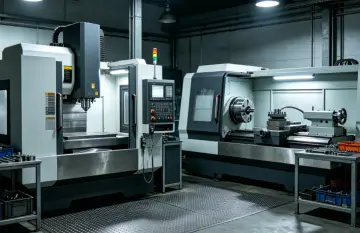
Horizontal Machining Center (HMC)
HMC adopts a horizontal spindle configuration, matched with a 360° rotary indexing table, with ultra-wide processing coverage. It is specially tailored for box-type, shell-type, and large structural parts. Typical applicable workpieces include hydraulic valve blocks, engine cylinder heads, equipment boxes, long-span structural frames, and AGV base steel structures.
Its horizontal spindle and rotary table can easily access the side walls, inner holes, and deep cavities of workpieces, perfectly adapting to the processing needs of tall, large, and complex box parts that VMCs cannot handle.
2. Chip Removal Performance Comparison: Light Cutting vs Heavy Cutting
Chip removal efficiency is a key factor affecting machining stability and workpiece surface quality, especially for long-term continuous processing and heavy stock removal scenarios.
VMC Chip Removal Effect
When a vertical machining center works, cutting chips fall vertically onto the worktable and workpiece surface. For shallow planar processing, chip removal is basically smooth; however, for grooving, deep hole drilling, and cavity processing, chips are easily trapped in workpiece grooves and inner cavities.
Accumulated chips will scratch the finished surface, affect machining accuracy, and require frequent manual shutdown cleaning. This leads to low automation efficiency, so VMC is more suitable for light cutting and small stock removal processing.
HMC Chip Removal Effect
The horizontal structure of HMC enables chips to fall freely from the workpiece surface by gravity, with almost no chip retention in inner cavities and side processing positions. Matched with the automatic chain plate chip conveyor, it realizes uninterrupted automatic chip removal.
This advantage makes horizontal machining centers the first choice for heavy cutting, large stock removal, and long-time unmanned processing. It effectively avoids workpiece scrapping and tool wear caused by chip accumulation, greatly improving production continuity.
3. Fixture Cost Analysis: Small-Batch Diversification vs Mass Production
Fixture investment is an easily overlooked hidden cost in machining center selection. VMC and HMC have completely different fixture design and use costs, adapting to different production modes.
VMC Fixture Cost Advantage
Vertical machining centers only support single-side clamping and single-surface processing. They can be matched with ordinary flat vises, simple positioning jigs, and universal fixtures, with low fixture design and manufacturing costs and short customization cycles.
For small-batch, multi-variable production scenarios with frequent workpiece switching, VMC can save a lot of fixture development costs. It requires no complex customized tooling and has low trial production and replacement costs, which is extremely cost-effective for flexible production.
HMC Fixture Cost Characteristics
To realize multi-face one-time processing, HMC needs to be equipped with high-precision rotary jigs, customized positioning fixtures, and multi-station tooling. The fixture design difficulty and manufacturing cost are significantly higher than VMC, with a higher one-time investment.
But in mass production scenarios, the comprehensive cost of HMC is lower: one clamping completes multi-face processing, eliminating repeated clamping and positioning errors, saving a lot of labor and time costs for secondary clamping, and reducing product rework rates.
4. Multi-Face Machining Demand: Single-Surface Forming vs Multi-Surface One-Time Forming
Multi-face processing capability is the core difference that determines the application boundaries of VMC vs HMC, and also the key basis for equipment procurement managers to make decisions.
VMC: Suitable for Single-Surface Machining
Limited by the vertical spindle and fixed table, VMC can only complete the processing of the top surface of the workpiece in one clamping. If side surfaces, end surfaces, and inner cavities need to be processed, multiple re-clamping and positioning are required.
Repeated clamping will inevitably produce positioning errors, which is not conducive to ensuring the overall dimensional accuracy of complex workpieces. It is only suitable for workpieces with simple structures and only single-surface processing requirements.
HMC: Suitable for Multi-Face Synchronous Machining
Equipped with a precision rotary table, the horizontal machining center can realize 4-sided or even 6-sided continuous processing of workpieces in one clamping. It can complete milling, drilling, boring, and tapping of all peripheral surfaces and inner cavities in one setup.
This one-time forming processing mode eliminates positioning errors caused by repeated clamping, greatly improves workpiece overall accuracy and processing efficiency, and is the best choice for high-precision complex box parts, long-span structural parts, and mass-produced multi-face workpieces.
Final Selection Summary: How to Choose VMC or HMC According to Workpieces
1. Choose Vertical Machining Center (VMC): For flat parts, molds, cover plates, and simple structural parts; small-batch multi-variable production; budget-sensitive projects with low fixture cost investment requirements and only single-surface processing needs.
2. Choose Horizontal Machining Center (HMC): For box parts, shell parts, long-span large structural parts, and deep-cavity complex parts; mass production scenarios requiring high efficiency and unmanned processing; workpieces with multi-face synchronous processing and high precision requirements; heavy cutting and large stock removal processing.
Conclusion
There is no absolute superiority between vertical vs horizontal machining center, only the most suitable one for production needs. Process planners and procurement managers should select equipment based on workpiece structure, processing faces, production batch, and cost budget. Reasonable machining center selection can maximize processing efficiency, control production costs, and stabilize product machining accuracy.

 Email
Email sales1: +86 15312799623