



VMC 1580 vs. Gantry Machining Center for Large Mold Making
A VMC 1580 vertical machining center is generally suitable for medium-to-large injection mold bases and die-casting inserts that fit its machining envelope and table-load capacity. A double-column gantry machining center is usually more appropriate for oversized stamping dies, heavy mold bases, and wide workpieces. Neither design automatically provides higher accuracy or faster cutting. Buyers should compare usable travel, spindle torque, workpiece capacity, structural rigidity, and total manufacturing cost.
For mold manufacturers, choosing between a VMC 1580 and a gantry machining center directly affects machining flexibility, setup requirements, and long-term equipment utilization.
A mold may fit on a machine's worktable but still exceed its effective cutting area. Heavy steel roughing can also expose limitations in spindle torque, tool rigidity, and thermal stability. Selecting a larger machine without sufficient production demand, meanwhile, can increase investment and operating costs unnecessarily.
This comparison focuses on conventional C-frame VMC 1580 machines and double-column gantry machining centers, helping international buyers determine which design better matches their mold sizes, machining operations, and production requirements.
VMC 1580 vs. Gantry Machining Center: Key Differences
The primary difference between a VMC 1580 and a double-column gantry machining center is their structural arrangement and available machining capacity.
A VMC 1580 typically uses a single-column C-frame structure. The spindle moves vertically, while the table and spindle assembly provide the required X, Y, and Z machining movements.
A double-column machining center uses two columns connected by a crossbeam. Depending on its design, it may use a moving table, moving bridge, or moving gantry arrangement.
For this comparison, the gantry examples are double-column moving-table machines designed for larger workpieces.
Machine Specifications: Travel, Table Load, and Spindle
The following table compares the published specifications of the Shandong XILI VMC 1580 with the Vision Wide SF-2116 and SF-3116 double-column machining centers.
| Specification | XILI VMC 1580 | Vision Wide SF-2116 | Vision Wide SF-3116 |
|---|---|---|---|
| Machine structure | C-frame | Double-column | Double-column |
| X-axis travel | 1,500 mm | 2,100 mm | 3,100 mm |
| Y-axis travel | 800 mm | 1,600 mm | 1,600 mm |
| Z-axis travel | 700 mm | 800 mm standard | 800 mm standard |
| Worktable dimensions | 1,700 × 800 mm | 2,000 × 1,500 mm | 3,000 × 1,500 mm |
| Maximum table load | 1,500 kg | 8,000 kg | 10,000 kg |
| Spindle motor power | 15/18.5 kW | 18.5/22 kW | 18.5/22 kW |
| Spindle taper | BT50 | Depends on configuration | Depends on configuration |
| Listed spindle speed | 8,000 rpm | 6,000 rpm, geared spindle | 6,000 rpm, geared spindle |
Sources: Shandong XILI VMC 1580 yw.xljc.cn and Vision Wide SF Series visionwide-tech.com. Vision Wide power values are continuous/30-minute ratings; XILI's published dual power figures do not specify an equivalent duty classification. Optional spindle configurations differ.
These specifications show two important differences.
First, the SF-2116 offers twice the Y-axis travel of the referenced VMC 1580, allowing a larger range of tool-center movement across wide mold components.
Second, the double-column machines have significantly higher published table-load capacities, making them potential candidates for heavy mold bases and large stamping dies.
However, larger machine dimensions do not guarantee higher cutting accuracy or material removal rates.
The comparison also applies only to these manufacturer configurations. The designation VMC 1580 does not represent one standardized machine specification across the industry.
How Do Machine Structures Affect Rigidity?
Machine rigidity is important for mold manufacturing because cutting forces can cause tool deflection, vibration, and dimensional deviations.
The VMC 1580's C-frame structure can provide sufficient stiffness for medium-sized mold bases, steel inserts, and conventional milling operations when properly designed.
A double-column structure provides a different load path through its two columns and crossbeam. This arrangement can be advantageous for wide machining envelopes and heavy workpieces.
However, structural layout alone does not determine tool-tip rigidity.
Actual machining performance also depends on:
- Machine casting and crossbeam construction
- Guideway spacing and type
- Spindle-head and ram extension
- Feed-drive and bearing stiffness
- Structural joints and foundation installation
- Cutting-tool length and workpiece clamping
For a simplified static loading condition:
k=F/δ
Where k is effective stiffness in N/μm, F is applied force in N, and δ is measured displacement in μm.
For example, an assumed 2,000 N force causing 10 μm displacement gives an effective stiffness of 200 N/μm at that measurement point.
This illustrative calculation does not represent a tested stiffness rating for either machine.
Buyers should distinguish between static rigidity, dynamic vibration behavior, and thermal stability. These factors affect machining differently, particularly during heavy roughing and long mold-finishing cycles.
Key takeaway: A double-column design may support larger machining envelopes, but actual cutting stability must be verified through machine specifications and representative cutting tests.
Which Spindle Configuration Is Better for Mold Machining?
Mold manufacturing usually requires a combination of heavy material removal and accurate surface finishing.
During roughing, spindle torque and available power at the intended cutting speed are especially important.
During finishing, spindle speed stability, runout, thermal behavior, tool balance, and contouring performance become increasingly significant.
The basic relationship between mechanical spindle power and torque is:
T=9550P/n
Where:
- T = spindle torque (N·m)
- P = available mechanical spindle power (kW)
- n = spindle speed (rpm)
For example, if a spindle delivers 15 kW at 1,000 rpm, its calculated torque is approximately 143 N·m.
This is a theoretical calculation, not an actual torque specification for the VMC 1580.
Actual available torque varies with motor characteristics, transmission type, speed, and operating duty.
A BT50 spindle may be suitable for substantial steel roughing, but the taper specification alone does not establish cutting capacity.
Similarly, a double-column machine can use different spindle configurations. The Vision Wide SF series, for example, lists geared spindle arrangements as well as optional higher-speed direct-driven and built-in configurations.
For rough mold machining, prioritize verified spindle torque and machine stability. For precision finishing, evaluate spindle runout, speed capability, thermal stability, and actual contouring results.
Which Machine Is Better for Different Types of Molds?
The most suitable CNC machining center depends on mold dimensions, workpiece weight, material, and manufacturing requirements.
| Mold application | Initial recommendation | Main selection factor |
|---|---|---|
| Medium injection mold bases | VMC 1580 | Workpiece fit and cutting capability |
| Large injection mold plates | Double-column machine | Machining travel and table-load capacity |
| Automotive stamping dies | Double-column machine | Large surface dimensions and accessibility |
| Medium die-casting mold inserts | VMC 1580 | Cutting stability and cavity access |
| Heavy die-casting mold assemblies | Double-column machine | Workpiece weight and machining envelope |
| Precision mold inserts | Configuration-dependent | Spindle and contouring accuracy |
These recommendations are initial selection directions rather than universal rules.
Injection Molds: When Is a VMC 1580 Sufficient?
Injection mold manufacturing commonly involves cavity milling, pocket machining, drilling, tapping, and surface finishing.
A VMC 1580 can be suitable for medium-to-large injection mold bases and inserts when the machining area and table-load rating meet the production requirements.
Its vertical spindle arrangement provides direct access to top-facing surfaces, cavities, and mounting features.
For larger mold plates, a double-column machining center offers a wider working range and potentially greater flexibility for positioning the workpiece.
However, when a mold already fits comfortably within the VMC's operating limits, the larger machine may offer little practical benefit.
Surface finish and dimensional accuracy should be evaluated separately from machine size. A properly configured VMC 1580 may outperform a larger but less suitable machine in specific finishing operations.
Automotive Stamping Dies: When Is a Gantry Machine Necessary?
Automotive stamping dies often require machining long or wide surfaces with complex three-dimensional geometry.
Their dimensions and weight frequently make double-column machining centers more suitable than conventional C-frame VMC machines.
For example, a stamping die requiring 2,200 mm of continuous X-axis tool-center movement exceeds the listed 1,500 mm travel of the XILI VMC 1580.
A machine such as the SF-3116, with 3,100 mm X-axis travel, provides a larger potential machining range.
However, buyers must also verify the distance between columns, tool-holder clearance, workpiece positioning, and the actual cutting envelope.
Large stamping dies may require side machining or additional tool orientations. In such cases, suitable angle heads or multi-axis configurations may reduce the number of setups.
For oversized dies, the gantry machine's main advantage is its larger usable machining space and loading capacity—not an automatic increase in cutting speed or accuracy.
Die-Casting Molds: What Matters for Roughing and Deep Cavities?
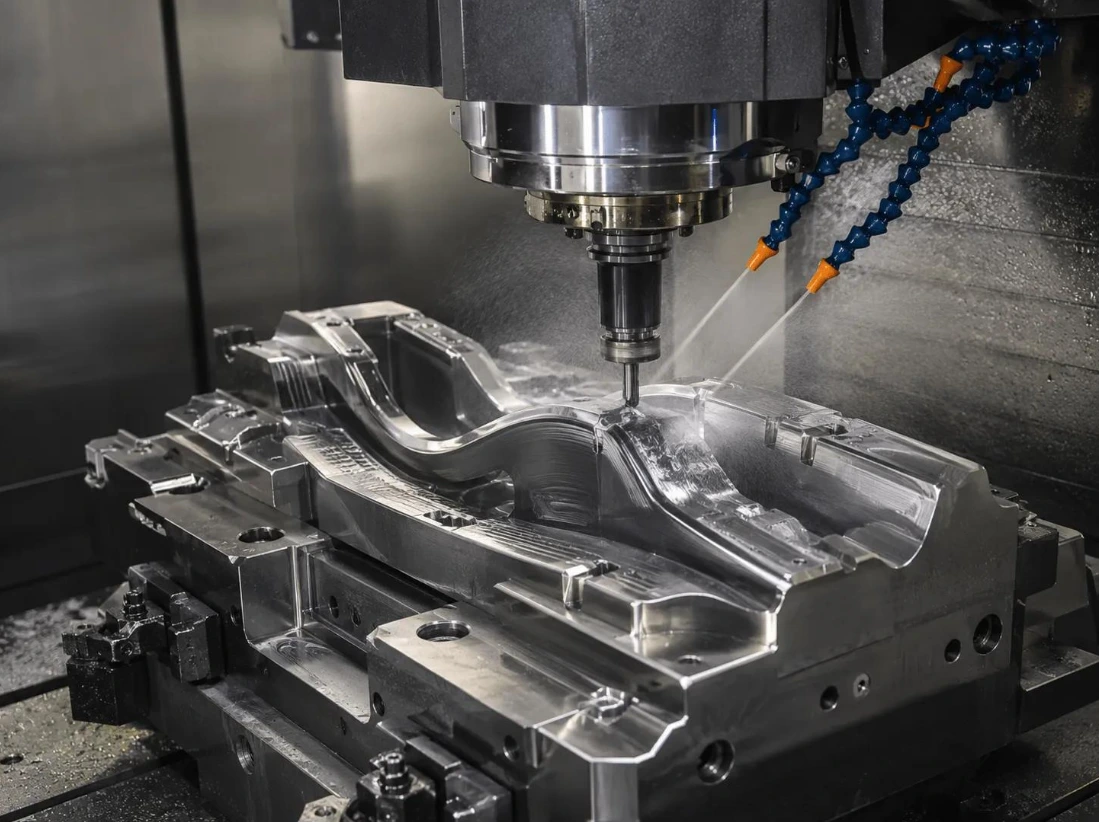
Die-casting molds commonly contain complex cavities, cooling features, and hardened tool-steel components.
For medium-sized inserts, a VMC 1580 equipped with sufficient spindle torque, stable feed drives, and suitable tooling may meet the machining requirements.
For heavy mold assemblies, a double-column machining center may offer greater table capacity and workpiece accessibility.
Deep cavities introduce another limitation: tool overhang.
A longer cutting tool generally experiences greater bending deflection under the same lateral cutting force. This can increase vibration, reduce dimensional accuracy, and affect surface finish.
Using a larger machine does not eliminate these problems.
Buyers should evaluate tool length, spindle clearance, cutter geometry, cutting parameters, and collision-free access.
Some mold manufacturers use double-column machines for large mold-base machining and separate high-speed machining centers for precision inserts or finishing. This can be a practical alternative to relying on one large machine for every operation.
Can a VMC 1580 Handle Your Mold Size and Weight?
A common purchasing mistake is assuming that a workpiece can be machined because its dimensions are smaller than the machine's worktable.
In practice, the mold, fixture, clamps, cutting tools, and required axis movements must all fit within the usable machining envelope.
How Much Machining Travel Does Your Mold Require?
Consider a hypothetical steel mold base with the following requirements:
| Parameter | Value |
|---|---|
| Mold length | 1,200 mm |
| Mold width | 650 mm |
| Mold height | 400 mm |
| Mold and fixture weight | 1,100 kg |
| Required operations | Face milling, cavity milling, drilling |
The cited XILI VMC 1580 provides a 1,700 × 800 mm worktable, 1,500/800/700 mm axis travel, and a rated table load of 1,500 kg.
The example workpiece falls below the listed table dimensions and total load capacity.
However, this does not prove that every required machining operation can be completed.
For a simplified external contour operation, the required tool-center movement can be estimated as:
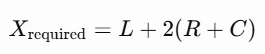
Where:
- L = required machining length
- R = cutter radius
- C = additional approach clearance at each end
If the machining length is 1,200 mm, cutter radius is 20 mm, and clearance is 30 mm:

This estimated 1,300 mm movement is within the listed 1,500 mm X-axis travel.
The calculation is an illustrative screening method, not a general formula for all mold toolpaths.
Complex cavities, machining outside the mold perimeter, work offsets, and machine-specific travel limitations may require a different envelope calculation.
Buyers should verify complete toolpath accessibility using a 3D machine simulation before placing an order.
How Do Tool Length and Fixture Height Affect Z-Axis Clearance?
The cited XILI VMC 1580 lists a spindle nose-to-table distance of 130–830 mm.
Suppose the mold is 400 mm high and the fixture raises it by 80 mm.
The nominal maximum distance from the spindle nose to the mold's top surface is:
830-400-80=350mm
This does not mean a 350 mm tool can automatically be used.
The complete tool assembly must accommodate the tool holder, cutter projection, required cutting depth, approach movements, and collision clearance.
The minimum spindle nose position must also permit the required cutting operation.
In addition, the 1,100 kg mold-and-fixture assembly must be assessed for table-load distribution, support points, and center of gravity.
A machine's maximum table-load rating does not mean that every eccentric or concentrated loading condition is acceptable.
Key takeaway: Select a VMC 1580 only when the complete workpiece setup, toolpath, table load, and machining clearances satisfy the specific machine's verified limits.
Which Machine Offers Better Machining Efficiency and Cost?
A gantry machining center does not inherently remove material faster than a VMC 1580.
If both machines use comparable spindle systems, tooling, cutting parameters, and stable machining conditions, their material removal rates may be similar.
The economic advantage of a larger double-column machine often comes from its ability to accommodate oversized molds, reduce workpiece repositioning, or avoid outsourcing.
Does a Gantry Machine Remove Material Faster?
During milling, the nominal material removal rate can be estimated using:
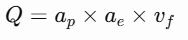
Where:
- Q = material removal rate (mm³/min)
- ap = axial depth of cut (mm)
- ae = radial width of cut (mm)
- vf = feed rate (mm/min)
For example, assuming a 3 mm cutting depth, 20 mm radial engagement, and 800 mm/min feed rate:
Q=3×20×800=48,000mm³/min
This is an illustrative calculation for a constant-engagement cutting operation.
Actual machining productivity depends on workpiece material and hardness, spindle torque, cutting-tool geometry, vibration, toolpath strategy, and non-cutting time.
The calculation cannot demonstrate that either machine category is faster.
For large mold manufacturing, the more meaningful comparison may be whether the machine can complete a required machining operation in one setup.
A larger machine may reduce repositioning and alignment work when the component exceeds the smaller machine's operating envelope.
Conversely, a VMC 1580 may provide sufficient productivity for molds that fit within its working range without requiring the additional capital investment of a gantry machine.
When Does a Gantry Machining Center Justify Its Higher Cost?
The initial equipment price is only part of the investment decision.
A buyer should compare machine acquisition, installation, energy use, maintenance, workpiece handling, and outsourcing expenses.
| Cost consideration | VMC 1580 | Double-column gantry machine |
|---|---|---|
| Initial investment | Typically lower | Typically higher |
| Required installation space | Generally smaller | Generally larger |
| Workpiece capacity | More limited | Higher in many configurations |
| Oversized mold production | May require outsourcing | May be completed in-house |
| Setup and repositioning | Depends on mold size | May reduce setups for larger workpieces |
| Maintenance requirements | Configuration-dependent | Configuration-dependent |
| Equipment utilization | Depends on order mix | Depends on order mix |
A simplified investment payback calculation is:
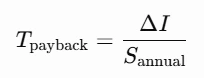
Where:
- △I = additional initial investment
- Sannual = annual net savings from the larger machine
For illustration, suppose a double-column machine costs USD 120,000 more and delivers verified net annual savings of USD 30,000 through reduced outsourcing and handling costs.
The simple payback period would be:

These are hypothetical financial inputs, not actual manufacturer quotations or customer results.
A complete investment assessment should also consider financing costs, depreciation, residual value, production demand, and maintenance exposure.
For factories manufacturing mostly medium-sized molds, a VMC 1580 may provide better equipment utilization.
For factories regularly producing oversized stamping dies or heavy mold bases, a double-column machine may offer a stronger economic case if its additional capacity generates measurable savings.
Key takeaway: The best-value machine is the one that meets the required production capability at the lowest justified total cost, not necessarily the one with the lowest purchase price.
What Accuracy Tests Should Mold Manufacturers Request?
Published accuracy specifications are useful for comparing machines, but they do not establish the dimensional accuracy of every finished mold.
A machine may meet its positioning specifications while still producing deviations caused by cutting forces, thermal displacement, fixture deformation, or tool wear.
International buyers should therefore request machine inspection reports and representative cutting demonstrations before purchasing.
Which ISO Standards Apply to CNC Machine Inspection?
The ISO 230 series provides methods for evaluating machine-tool performance.
| Inspection | Relevant standard | Main purpose |
|---|---|---|
| Geometric accuracy | ISO 230-1 | Evaluate specified machine geometric errors |
| Positioning and repeatability | ISO 230-2 | Evaluate numerically controlled axis positioning |
| Thermal effects | ISO 230-3 | Assess temperature-related machine displacement |
| Circular contouring | ISO 230-4 | Evaluate circular interpolation performance |
The applicable standard edition, test positions, environmental conditions, and contractual acceptance limits should be agreed upon before testing.
The standards provide test procedures; they do not automatically certify the machines discussed in this article.
For reference, the XILI VMC 1580 product page specifies positioning accuracy of ±0.004 mm and repeat positioning accuracy of ±0.003 mm. These are manufacturer-declared specifications, not independent measurements of actual mold machining results.
Buyers should distinguish among positioning accuracy, repeatability, circular contouring, thermal stability, and finished-part dimensional accuracy.
Each measures a different aspect of machining performance.
What Should a Factory Acceptance Test Include?
A factory acceptance test should use the quoted machine configuration and clearly defined measurement conditions.
For mold-manufacturing applications, request the following evidence:
- Positioning accuracy report: Recorded axis positioning and repeatability measurements, including measurement equipment and test method.
- Representative cutting demonstration: Workpiece material, cutter geometry, spindle speed, feed rate, cutting depth, and spindle load.
- Finished-part inspection: CMM or calibrated measurement results covering specified critical dimensions.
- Surface finish measurements: Actual roughness readings, such as Ra in μm, where relevant.
- Thermal stability records: Measured displacement or dimensional variation over an agreed operating period.
A continuous machining video can support the evidence package, particularly when it shows controller readings and the machining process.
However, video alone cannot prove dimensional accuracy or long-term reliability. The footage should be accompanied by numerical inspection records that identify the machine, test workpiece, date, and measurement conditions.
For production-cost claims, buyers should request actual cycle-time, setup-time, downtime, and energy-consumption records.
No independently verified 12-month production dataset is available for the specific machines compared here. Therefore, the article does not claim a measurable productivity improvement, energy reduction, or guaranteed return on investment.
Frequently Asked Questions About VMC 1580 and Gantry Machining Centers
Q1: Is a VMC 1580 suitable for large injection mold manufacturing?
A: Yes, provided the mold, fixtures, and required toolpaths fit the machine's usable machining envelope and table-load capacity.
For the referenced XILI configuration, X/Y/Z travel is 1,500/800/700 mm, with a maximum table load of 1,500 kg.
Larger or heavier molds may require a double-column machining center. Buyers must also check spindle clearance, fixture height, and tool access.
Q2: Does the double-column structure guarantee greater machining precision?
A: No. A double-column structure can provide a favorable arrangement for large workpieces, but finished-part accuracy depends on machine geometry, spindle performance, thermal behavior, servo control, cutting forces, and workholding.
Buyers should compare actual inspection reports rather than relying on machine size or structural layout alone.
Q3: Should manufacturers choose a VMC 1580 or a gantry machine for heavy cutting?
A: A double-column machine is often a practical candidate for large, heavy steel molds because it provides greater working space and load capacity.
However, a properly configured VMC 1580 can also perform substantial roughing if its spindle torque, structural stiffness, tool system, and workpiece capacity are sufficient.
A representative cutting test is the most reliable way to compare the proposed configurations.
Q4: Which machine offers better value for mold manufacturers?
A: A VMC 1580 may be more economical when most molds fit within its machining capacity and the larger machine would be underutilized.
A double-column machine may justify its higher cost when oversized molds would otherwise require outsourcing, multiple setups, or additional handling.
The final decision should be based on verified quotations, expected production volume, operating costs, and investment payback.
Q5: Which technical parameters should buyers prioritize?
A: Start with the largest expected mold dimensions, workpiece weight, and machining operations.
Then compare usable X/Y/Z travel, table capacity, spindle clearance, spindle torque, structural rigidity, tool capacity, positioning accuracy, and thermal stability.
Before purchasing, request complete machine drawings, spindle performance data, accuracy inspection reports, and a cutting demonstration using representative machining conditions.
Conclusion: Which Machine Should You Choose for Mold Making?
For manufacturers producing medium-to-large injection molds, mold bases, and die-casting inserts, a VMC 1580 vertical machining center can be a practical option when its usable machining envelope, load capacity, and cutting performance meet the production requirements.
A double-column gantry machining center is generally more suitable for oversized automotive stamping dies, heavy mold assemblies, and large workpieces that require extended machining travel.
However, neither machine category automatically guarantees higher accuracy, faster machining, or lower manufacturing costs.
The most reliable selection process is to verify workpiece compatibility first, evaluate cutting and accuracy requirements second, and compare total production economics third.
For international equipment buyers, reviewing actual machine specifications, factory inspection records, and representative cutting tests provides a stronger basis for investment than choosing equipment solely by size, machine category, or advertised performance.

 Email
 sales1: +86 15312799623